
Home › Firefighter Aptitude Test › CPS Firefighter Test
CPS Firefighter Test Canada 2026: Free Practice Questions + Real Audio Listening Prep
The CPS firefighter test is an entry-level exam published by CPS HR Consulting. For Ontario candidates, the 2024 Innisfil recruitment guide hosted by Firefighter Services of Ontario names a CPS Aptitude Examination. FSO’s current aptitude outline lists four skill areas and a 70% pass requirement without naming a publisher or version. Use your current invitation to confirm the test, timing and rules you will face.
This free CPS firefighter test study guide covers the format, the scoring, and real sample questions with full explanations for every section — including the audio oral-comprehension section that surprises many first-time candidates. When you’re ready for serious CPS firefighter test prep, our full CPS practice test bundle includes a complete 100-question timed simulation.
Free video lesson · 11 minutes
Watch a free CPS practice lesson
Practise listening, reading, math and mechanical reasoning with original questions and worked explanations. Follow a spoken briefing, check an equipment policy, solve quantities and net rates, then watch animated gears and pulleys.
Watch on YouTube (opens a new tab)
Try the listening challenge: listen once before answering. Turn captions off for audio-only practice, or keep them on for the transcript. This is a practice choice; follow your test administrator’s playback and note-taking instructions.
Put the method into practice
Choose one skill to work on next with the FireRecruitment firefighter aptitude practice bundle:
- A dedicated CPS study guide
- Fresh original questions and recorded listening exercises
- Worked explanations to help you review mistakes
$97 CAD
One payment · 12 months of access · No subscription
This lesson focuses on the four skill areas listed by Firefighter Services of Ontario. It is independent preparation, not a full exam simulation or actual exam content, and is not affiliated with or endorsed by CPS HR Consulting or FSO. CPS versions differ: confirm the sections, timing, question count and rules in your current invitation. The lesson’s 70% pass threshold refers to FSO’s administration only; preparation does not guarantee a result or hiring outcome. Its ideal pulley models ignore friction and rope/pulley weight and are not operational lifting instruction.
CPS Firefighter Exam Format: The Facts at a Glance
- Exam: CPS Firefighter Entry-Level exam, administered in Ontario by FireOntario. Multiple choice.
- Four content areas: understanding oral information, reading comprehension, mathematical ability, and mechanical aptitude.
- Pass mark: 70%.
- Fee & validity: $90 CAD; results are valid for 1 year (as of July 2026).
- Length: According to CPS HR Consulting’s 2026 test catalog, every metric (Canadian) version of the entry-level firefighter exam is 100 questions with a 2-hour limit. FireOntario doesn’t publish the count itself.
- Rules: no calculators or phones; all materials are supplied at the test centre; accommodations are available with one week’s notice.
On this page
Which Ontario Fire Departments Use the CPS Firefighter Test?
FireOntario partners with a growing list of departments — mostly across the Niagara region, central Ontario and the north — plus a few organizations outside Ontario that accept the same exam. Recent recruitments running CPS/FireOntario testing (as of July 2026) include Niagara Falls, Innisfil, Burlington, Sault Ste. Marie, Windsor and St. Catharines.
See the full FireOntario partner list (as of July 2026)
- City of Greater Sudbury – Greater Sudbury Fire Services
- Township of Uxbridge – Uxbridge Fire Department
- City of St. Johns -St. Johns Fire Services
- City of Thorold – Thorold Fire Services
- City of St. Catharines – St. Catharines Fire & Emergency Services
- City of Port Colborne – Port Colborne Fire & Emergency Services
- City of Pembroke – Pembroke Fire Department
- City of Orillia – Orillia Fire Department
- Niagara on the Lake -Niagara on the Lake Fire Department
- City of Niagara Falls – Niagara Falls Fire Department
- City of Milton – Milton Fire Department
- Middlesex County – Middlesex County Fire Department
- Town of Lincoln – Lincoln Fire Department
- Town of Innisfil – Innisfil Fire Services
- Town of Ingersoll – Ingersoll Fire & Emergency Services
- Hamilton International Airport
- Town of Halton Hills – Halton Hills Fire & Rescue
- Haldimand County -Haldimand County Fire Services
- Town of Grimsby -Grimsby Fire and Emergency Services
- Township of Georgina – Georgina Fire Service
- Fort Erie – Fort Erie Fire Rescue
- Town of Deep River – Deep River Fire Services
- Town of Collingwood – Collingwood Fire Department
- Chippewas of Rama First Nation – Chippewas of Rama First Nation Fire and Emergency Services
- Canadian Armed Forces
- City of Edmonton
- City of Burlington – Burlington Fire Department
Partner departments change over time — always confirm the required test on the posting itself.
Free CPS Firefighter Test Sample Questions
Try one question (or two, for audio) from each skill area below: the four FSO categories plus two formats found in other CPS versions. Practise without a calculator. For listening, try a single pass without notes, then review; your administrator’s instructions determine the rules on test day. Answers and explanations are under each question.
Questions 1 & 2 – Understanding Oral Information
Listening challenge: press play, listen once, then answer. Replay is available in this sample; follow your administrator’s actual test instructions.
Some departments allow notes, some don’t — train without them so you’re ready either way.
At what time was the call received?
- A.14:20
- B.14:02
- C.14:21
- D.15:30
Show answer & explanation
Correct answer: A.
The dispatcher stated ‘time of call, 14:20.’ The message ended with ‘dispatch clear, 14:21’ — a one-minute-later time designed to be confused with the call time, so attach each time to its label as you hear it.
Which statement matches what the dispatcher said about the occupants?
- A.All three occupants were confirmed outside on the front lawn
- B.One occupant was outside and two were in the basement
- C.Two occupants were outside and a third was confirmed trapped on the second floor
- D.Two occupants were outside and a third might still be in the basement
Show answer & explanation
Correct answer: D.
Two occupants were confirmed outside; the caller only BELIEVED a third might be in the basement. Track certainty words like ‘confirmed’ versus ‘believes’ or ‘possibly’ — distractors upgrade a possibility into a confirmed fact or move the location.
About this section
- Tests single-pass listening recall: names, numbers, addresses, 24-hour times and the order of instructions in a dispatch-style recording.
- Roughly 20 of the 100 questions are oral-information items, per the publisher’s catalog (FireOntario doesn’t publish counts).
- Candidates consistently report the passage is played once, with no replay.
- Some departments allow notes, some don’t — train without them so you’re ready either way.
- Strategy tip: attach every number to its label as you hear it (“call time 14:20”, “address 41”) — the wrong options are almost always the right digits attached to the wrong label.
Question 3 – Reading Comprehension
At 02:14, Engine 7 was dispatched to a reported house fire on Maple Street in Kingston. Captain Diaz arrived first and reported smoke showing from the second floor of a two-storey wood-frame home. A neighbour on the lawn told the captain that an elderly resident, Mr. Byrne, used a bedroom at the rear of the house and might still be inside.
Captain Diaz ordered a primary search while the crew stretched a hose line through the front door. Firefighter Nowak located Mr. Byrne in the rear bedroom, disoriented but conscious, and guided him to the front lawn where paramedics took over. Meanwhile, the hose crew advanced to the base of the stairs but found the fire had extended into the ceiling.
Recognizing the risk of the fire spreading through the attic, Captain Diaz requested a second engine and ordered the roof to be opened for vertical ventilation. Once the roof was cut, heat and smoke lifted noticeably, and the interior crew was able to knock down the main body of fire within eight minutes. Overhaul revealed the fire had started in a space heater left running near curtains. No firefighters were injured, and Mr. Byrne was treated for smoke inhalation and released. Captain Diaz noted in her report that the neighbour’s information was critical to the rescue.
In what order did the following events occur?
- A.Roof cut for ventilation → primary search ordered → Mr. Byrne rescued
- B.Primary search ordered → roof cut for ventilation → main fire knocked down
- C.Main fire knocked down → primary search ordered → roof cut for ventilation
- D.Mr. Byrne rescued → primary search ordered → second engine requested
Show answer & explanation
Correct answer: B.
The narrative sequence is: Captain Diaz ordered a primary search, then after finding fire in the ceiling ordered the roof cut for vertical ventilation, after which the interior crew knocked down the main body of fire.
About this section
- Tests main idea, specific detail and event-order questions on incident narratives, memos and policy extracts.
- Roughly 30 of the 100 are written-information questions, per CPS HR Consulting’s catalog — FireOntario doesn’t publish per-section counts.
- Every answer is in the passage — no firefighting knowledge is required or rewarded.
- Strategy tip: for sequence questions, number the events in the margin as you read; distractors reshuffle real events rather than inventing fake ones.
Question 4 – Mathematical Ability
A pumper travels 18 km to a scene at an average speed of 54 km/h. How many minutes does the trip take?
- A.15 minutes
- B.20 minutes
- C.25 minutes
- D.18 minutes
Show answer & explanation
Correct answer: B.
Time equals distance divided by speed: 18 divided by 54 equals 1/3 hour, which is 20 minutes.
About this section
- Covers arithmetic, percentages, ratios, unit conversion and crew/equipment/time word problems — all in metric units.
- Roughly 25 of the 100 are math questions, per the publisher’s catalog.
- No calculator is allowed — that’s official — so practise clean pencil arithmetic under time pressure.
- Strategy tip: convert to the answer’s units first (hours → minutes, litres → millilitres) before computing; most wrong options are correct math in the wrong unit.
Not sure where you stand?
Take our free 15-question firefighter aptitude readiness quiz — instant scoring.
Question 5 – Mechanical Aptitude
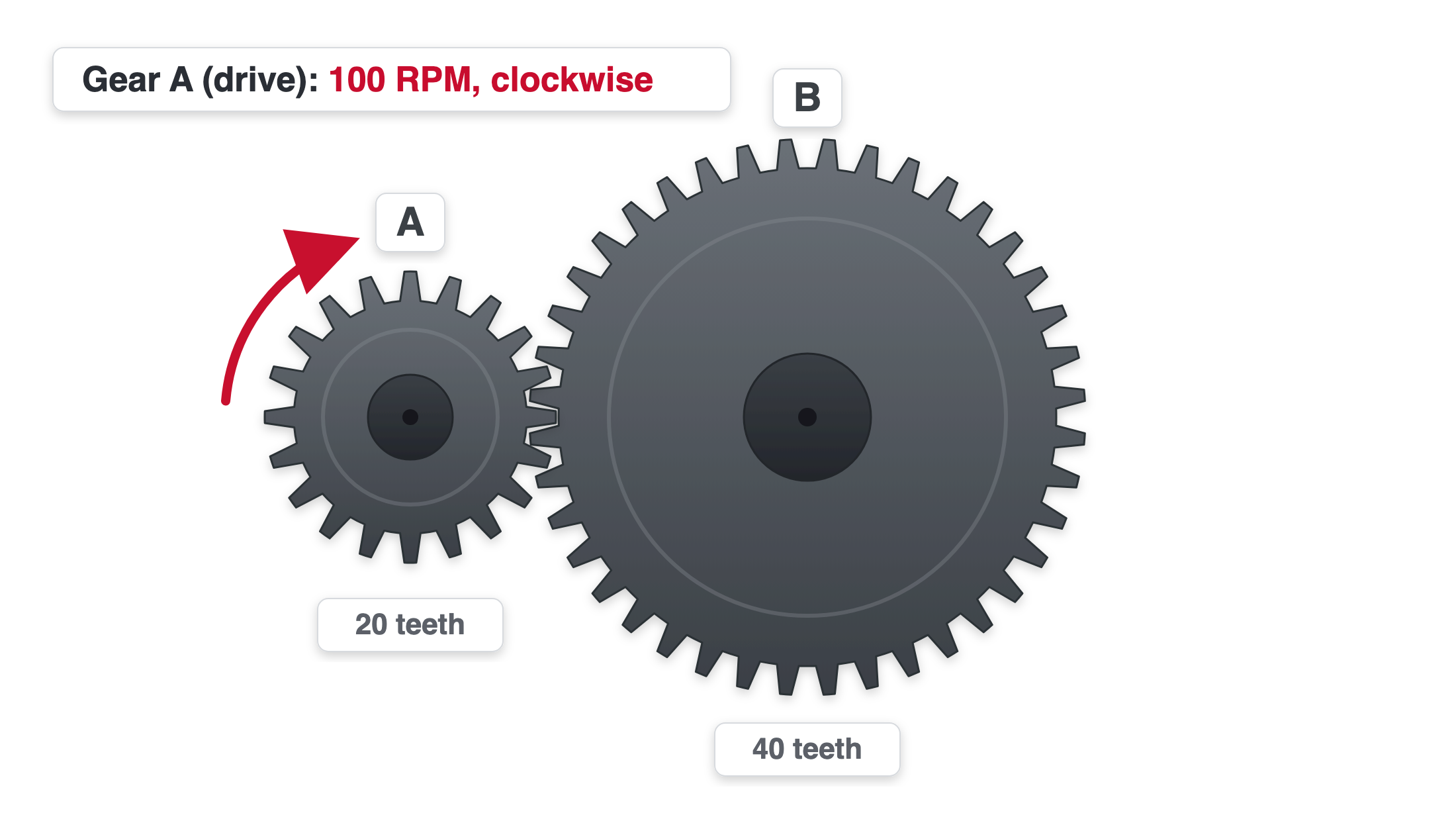
Gear A has 20 teeth and meshes with Gear B, which has 40 teeth. If Gear A turns at 100 RPM, how fast does Gear B turn?
- A.50 RPM
- B.200 RPM
- C.100 RPM
- D.400 RPM
Show answer & explanation
Correct answer: A.
Meshed gears: (teeth A × RPM A) = (teeth B × RPM B). 20 × 100 = 40 × RPM B, so RPM B = 2000 ÷ 40 = 50 RPM. The larger gear turns slower.
About this section
- Tests gears and rotation, levers, pulleys, pressure and fluid basics, and hand-tool selection — reasoning, not trade knowledge.
- On the metric CPS version this material sits inside the combined maps, diagrams and mechanical reasoning section — roughly 25 questions out of 100, per the publisher’s catalog.
- Everything can be reasoned from everyday physics; memorize a handful of rules (gear direction alternates, pressure grows with depth, longer lever = less force).
- Strategy tip: for gear trains, skip the middle gears — count the meshes: an even number of meshes means the last gear matches the first.
Question 6 – Maps & Diagrams
Part of the maps, diagrams and mechanical reasoning section on the metric CPS version.
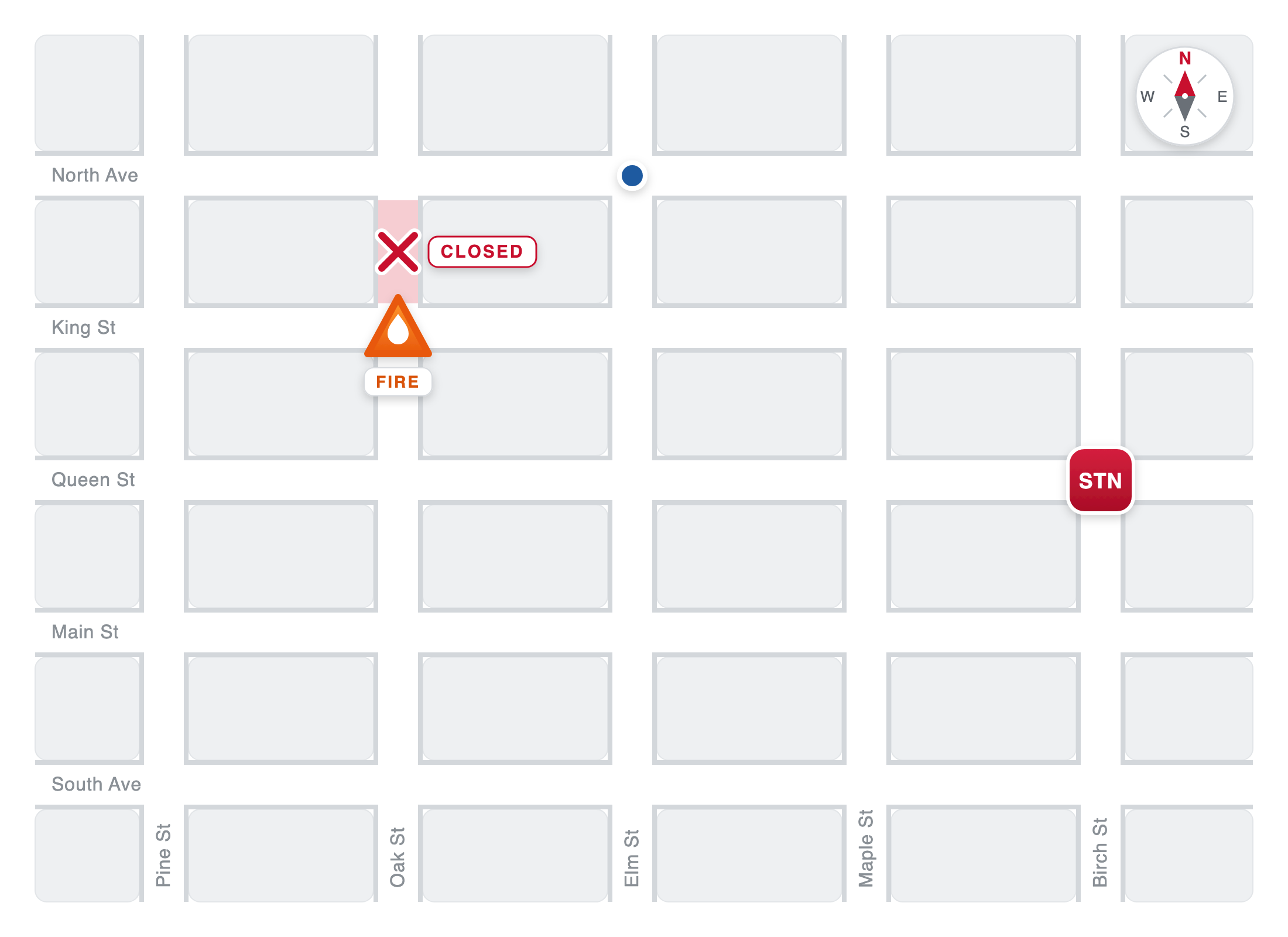
The engine is at Birch St and Queen St (STN); the fire is at Oak St and King St. Oak St is CLOSED between North Ave and King St, and King St is one-way EASTBOUND only. Which approach is valid?
- A.West on Queen St to Oak St, then north on Oak St to King St
- B.West on King St from Birch St directly to Oak St
- C.North on Birch St to North Ave, west to Oak St, then south on Oak St to King St
- D.Both A and C are valid
Show answer & explanation
Correct answer: A.
Route B travels westbound on a one-way eastbound street — not allowed. Route C needs the closed block of Oak St between North Ave and King St. Route A uses open two-way streets and arrives legally.
About this section
- Tests compass directions, street-map routing, grid coordinates and relative-position logic (“behind”, “to the left of”, bird’s-eye view).
- Shares the roughly 25-question maps/diagrams/mechanical section with mechanical aptitude on the metric version, per the publisher’s catalog.
- Orientation flips are the classic trap: a vehicle’s “left” depends on which way it faces, not which way you’re looking at the page.
- Strategy tip: sketch a quick north-up diagram for every relative-position question — ten seconds of drawing beats thirty seconds of mental rotation.
Question 7 – Teamwork, Public Relations & Community Living (SJT)
Appears on several CPS versions; not one of the four categories FireOntario currently names.
What is the BEST response?
- A.Tell him the damage is standard procedure and he should take it up with his insurance company.
- B.Acknowledge how distressing the damage is, explain in plain language why the ceiling was opened — hidden fire spread — and offer to have the officer walk him through what was found and what happens next.
- C.Ignore the comment and keep loading hose; the officer handles all homeowner interactions.
- D.Apologize and agree the crew probably overdid it, to defuse his anger.
Show answer & explanation
Correct answer: B.
B pairs empathy with a plain-language operational explanation and connects him with the officer, turning “you destroyed my kitchen” into an understanding of why the work protected his home. A may be technically true but is cold and deflecting at the worst possible moment, and C leaves an angry resident feeling ignored at the peak of his distress. D buys calm by falsely conceding the crew erred, which is unfair to the crew and problematic if a claim follows.
About this section
- Tests judgment in crew conflicts, public complaints, community education and professionalism scenarios — one BEST answer out of four.
- The strongest answers pair empathy or safety with communication up the chain; the traps are doing nothing, over-escalating, or falsely conceding fault.
- Worth practising even if your sitting is the four-category FireOntario variant — the same judgment shows up again at interview.
- Strategy tip: eliminate the two extremes first (ignore it / go nuclear); the best answer usually addresses the person AND informs the officer.
Question 8 – Written Communication
Appears on several CPS versions; not one of the four categories FireOntario currently names.
Choose the version of the radio-log entry that is written correctly.
- A.Pump 3 reported that it’s water supply was secure at 09:15.
- B.Pump 3 reported that its water supply were secure at 09:15.
- C.Pump 3 reported that its water supply was secure, at 09:15.
- D.Pump 3 reported that its water supply was secure at 09:15.
Show answer & explanation
Correct answer: D.
“Its” is the possessive; “it’s” (option A) always means “it is,” which makes no sense here. Option B pairs the singular subject “supply” with the plural verb “were,” and option C inserts an unnecessary comma before the time. Test any “it’s” by expanding it to “it is.”
About this section
- Tests spelling, punctuation and grammar through near-identical sentence versions and error identification — set in incident reports, memos and radio logs.
- Canadian spellings (colour, metre, behaviour) are the correct ones on Canadian sittings — American variants are used as distractors.
- Errors are subtle by design: its/it’s, subject-verb agreement, stray commas — built to be missed at reading speed.
- Strategy tip: compare the four versions one difference at a time instead of reading each sentence whole; expand every “it’s” to “it is” as a test.
Did You Know?
FireOntario requires 70% to pass, and results are ranked — most postings draw hundreds of applicants for a handful of spots. Training to “comfortably above 70%” is what actually gets you on the hiring list.
FAQ
How many questions is the CPS firefighter test, and how long do I get?
According to CPS HR Consulting’s 2026 test catalog, every metric (Canadian) version of the entry-level firefighter exam is 100 questions with a 2-hour limit. FireOntario doesn’t publish the count itself. The metric version whose sections match FireOntario’s four categories breaks down as roughly 20 oral information, 30 written information, 25 mathematics and 25 maps/diagrams/mechanical questions.
What score do I need to pass the CPS firefighter test?
FireOntario requires 70% to pass. Results are also ranked, so departments hiring from the pool see where you placed — aim well above the pass line, not at it.
Can I use a calculator or take notes on the CPS test?
No calculators or phones are allowed, and all materials are supplied at the test centre — that’s official. For notes in the oral section: Some departments allow notes, some don’t — train without them so you’re ready either way.
How much does the CPS test cost, and how long are results valid?
The test fee is $90 CAD and your results are valid for 1 year (as of July 2026). Accommodations are available with one week’s notice.
Which Ontario fire departments accept CPS/FireOntario results?
As of July 2026 the FireOntario partner list includes Burlington, Niagara Falls, St. Catharines, Milton, Greater Sudbury, Halton Hills, Innisfil, Collingwood, Orillia, Fort Erie, Grimsby and many more — see the full list higher on this page. Recent recruitments have included Niagara Falls, Innisfil, Burlington, Sault Ste. Marie, Windsor and St. Catharines. Always confirm the required test on the job posting.
What happens after I pass the written test?
The written exam is stage one. FireOntario’s remaining stages (each with its own fee, as of July 2026) include the CPAT physical test ($200), Clinical assessment ($130), Medical ($100), Acrophobia test ($40), Tread Water test ($40) and Emotional Stability and Resiliency (ESR) ($130). Under open testing you can pre-qualify up to 6 months in advance, so many candidates complete these before a posting even opens.
How is the CPS test different from the OS (Gledhill-Shaw) test?
Do not assume that an older “OS” or “Gledhill-Shaw” reference identifies today’s assessment. We have not verified a current official OS format or a formal rename to FSO. FSO’s published aptitude requirements cover oral information, reading, math and mechanical aptitude. Ask the recruiting department to confirm your current provider and exam before choosing a practice track. See our FSO and Gledhill Shaw guide for the distinction.
Prefer working through this material with a coach? Our firefighter aptitude test tutoring covers every CPS section one-on-one.
Firefighter Aptitude Practice Test Bundle
All four FireOntario categories — audio oral comprehension, reading, math, and maps/diagrams/mechanical — plus SJT and written-communication banks for other CPS versions, and a full 100-question, 2-hour exam simulation with the 70% pass line. Includes the FR Study Series — a dedicated CPS study guide plus 15 more, with lessons and worked examples.
365-day accessPriced in CAD
Not your test?
Ontario and Canadian departments use several different exams. Guides for the others:
What to Look For in Any Firefighter Test Prep
Whichever provider you choose — including us — hold it to these six checks before you pay:
- ✓Matches the exact test your department names. FACT, NFST, FSO/CPS and FireTEAM are different exams with different sections — generic “firefighter test” packs waste your prep time. See our overview of every Canadian firefighter aptitude test if you’re not sure which one you face.
- ✓Format fidelity, not just topic coverage. If your exam delivers passages by audio or scenarios by video, text-only practice trains the wrong skill. Look for single-play audio for listening sections and scenario continuity for video-based tests.
- ✓Worked explanations for every question. An answer key tells you what you got wrong; a worked explanation tells you why — that’s where score improvement actually comes from.
- ✓Canadian content and units. Metric distances, Canadian spellings, Canadian department contexts — and pricing clearly labeled in CAD, so there’s no exchange-rate surprise at checkout.
- ✓Access that matches a real recruitment cycle. Canadian hiring processes run months, not weeks. Clear one-time pricing with long access beats short timed windows you may have to re-buy mid-process.
- ✓Facts it can source. Good prep cites the test owner’s official pages, dates its claims, and says so honestly when a number (like a pass mark) simply isn’t published — instead of asserting one.
firerecruitment.ca is not affiliated with CPS HR Consulting or Firefighter Services of Ontario. All sample questions on this page are original works created for practice purposes and do not reproduce actual exam content. Test formats, fees and department lists change — always confirm details on the official posting. Format details verified 2 July 2026 against official sources where available.
Testing in B.C.? Many B.C. departments — Surrey, Richmond, Coquitlam, Abbotsford and more — screen through the BL Associates psychometric battery instead. Read our BLA firefighter test guide.