
← Firefighter Aptitude Tests in Canada
OFAI FACT Test 2026: 110 Questions, 45/55 Weighting & Free Sample Questions
The OFAI FACT test (Firefighter Aptitude and Character Test) is Stage One of the Ontario Fire Administration Inc. candidate testing process — the exam that stands between you and an application to Toronto Fire Services, Ottawa Fire Services, and dozens of other Ontario departments. It packs 110 multiple-choice questions into a single proctored sitting of up to 3 hours, and more than half of your result comes from a section most candidates barely prepare for: Personal Characteristics.
This guide covers the verified format, the 45/55 scoring split, booking and retake rules, and one free practice question for every section. When you are ready to train seriously, our full FACT practice test bundle covers every section with Canadian-written questions — or start with the free firefighter aptitude practice test (no email required).
Free video lesson · About 10 minutes
Watch a free OFAI FACT practice lesson
Practise reading, mathematical reasoning, map reading, writing and character reasoning with original teaching examples. Apply a written condition, calculate percentages and rates, trace a route around closures and one-way streets, compare sentence wording, and work through an accountability scenario.
Watch on YouTube (opens a new tab)
Try it before the answer: Pause to try each exercise before the explanation. Use the character scenario to think through accountability; it is not a verified replica of a live FACT item. When a question asks about your own behaviour or preferences, read it carefully and answer honestly.
Put the method into practice
Choose one skill to work on next with the FireRecruitment firefighter aptitude practice bundle:
- A dedicated OFAI FACT study guide
- Original FACT-focused practice questions and skill drills
- Worked explanations to help you review mistakes
$97 CAD
One payment · 12 months of access · No subscription
This lesson covers preparation for OFAI Stage One, the Firefighter Aptitude and Character Test (FACT), not OFAI’s physical or technical skills assessments. It uses original teaching examples, not actual exam questions or a full exam simulation. Confirm current timing, permitted materials and any linked assessments in your OFAI account and Stage One guide. FireRecruitment.ca is independent of OFAI and FPSI, with no sponsorship or endorsement. Preparation does not guarantee a test result or hiring outcome.
OFAI FACT Test at a Glance (2026)
| Questions | 110 multiple choice: Reading 15, Math 15, Map Reading 10, Writing 10, Personal Characteristics 60 (official OFAI outline) |
| Time | Up to 3 hours, one sitting, proctored computer lab (FESTI, Mississauga) (official) |
| Weighting | 45% aptitude / 55% character (official) |
| Result | Pass/fail only — no numeric score released, no published pass mark |
| Fee | $75 + HST, booked through your OFAI account |
| Certificate | Posted to your OFAI account within 3 business days; valid 24 months |
| Retakes | Wait 15 days after a first unsuccessful attempt, 30 days after subsequent attempts |
The FACT is published by FPSI (Fire & Police Selection Inc.) and administered in Ontario by OFAI. No per-section time limits are published; prep providers report that no calculator is allowed and there is no penalty for wrong answers, so answer every question.
What Is the OFAI FACT and Who Needs It?
OFAI Stage One certification is the standardized written entrance exam for a large share of Ontario’s municipal fire departments. Toronto Fire Services and Ottawa Fire Services both officially require OFAI candidate testing certificates on their own recruitment pages, and OFAI lists more than thirty additional departments that accept or require the FACT (full list below). You book the test yourself through ofai.ca, sit it at a proctored computer lab at the Fire & Emergency Services Training Institute (FESTI) in Mississauga, and the certificate lands in your OFAI account — departments then verify it when you apply.
Unlike most firefighter aptitude exams, the FACT is not primarily an academic test. The four aptitude sections — reading, math, map reading, and writing — total 50 questions and 45% of your result. The other 60 questions measure personal characteristics and count for 55%. That split is the single most important thing to understand before test day.
FACT Test Format: 110 Questions in Five Sections
Here is the official section breakdown from OFAI, with a free practice question in the FACT format for each section. Work through them honestly — pick your answer before opening the explanation.
1. Reading Ability — 15 questions
You read fire-service passages — policies, memos, incident narratives — and answer questions about their main idea, specific details, and how the rules apply to new situations. Try this one:
Sample question — Reading Ability
POLICY MEMO — STATION VISITOR POLICY (EFFECTIVE IMMEDIATELY)
TO: All Personnel
FROM: Deputy Chief R. Okafor
RE: Revised Station Visitor Policy
Our stations are working environments containing apparatus, equipment, and hazardous materials. To keep both visitors and personnel safe, the following visitor policy takes effect immediately and replaces all prior guidance.
All visitors must sign in at the watch desk and receive a numbered visitor badge, which must be worn visibly at all times. A member of the on-duty crew must escort visitors whenever they are in the apparatus bay, the equipment rooms, or any area where tools or hazardous materials are stored. Visitors are never permitted in these areas alone.
Scheduled tours for community groups, such as school classes and scout troops, require at least three business days’ notice and approval from the station captain. Tour groups larger than fifteen people must be split so that each sub-group has its own escort. Media visits and photography require prior approval from the Public Information Officer, not the station captain.
If an alarm sounds during a visit, the escorting member will direct all visitors to the designated safe assembly point in the front parking lot and account for them before the apparatus departs. Visitors must not re-enter the building until an officer declares it clear. Personnel who observe an unescorted or unbadged visitor must challenge that person politely and notify the officer in charge at once.
A scout troop of 24 children arrives for an approved tour. Based on the policy, what must happen?
- A. The tour must be cancelled because the group is too large
- B. The group must be split so each sub-group has its own escort
- C. The whole group may proceed with a single escort
- D. The children may tour the apparatus bay unescorted if badged
Show answer & explanation
Answer: B. The policy states tour groups larger than fifteen people must be split so that each sub-group has its own escort; 24 exceeds fifteen, so the group must be divided with separate escorts.
About this section
- 15 questions (official count per ofai.ca); no per-section time limit is published, so pace yourself within the 3-hour sitting.
- Tests main idea, specific details, vocabulary in context, and applying written rules to new scenarios.
- Passages are workplace documents — memos, SOPs, incident reports — not literature.
- Strategy tip: for “apply the rule” questions like the one above, find the exact sentence with the threshold or condition before looking at the options — the wrong answers are built from near-miss readings of it.
2. Mathematical Reasoning — 15 questions
Arithmetic, percentages, rates, and multi-step word problems set in fire-service contexts. Prep providers report no calculator is permitted, so practise clean mental and paper arithmetic.
Sample question — Mathematical Reasoning
A firefighter earns $28 per hour and 1.5 times that rate for overtime. On a shift they work 8 regular hours and 4 overtime hours. What is their total pay?
- A. $392
- B. $336
- C. $400
- D. $364
Show answer & explanation
Answer: A. Regular pay is 8 times $28 equals $224. Overtime is 4 times $42 (1.5 times 28) equals $168. Total is $224 plus $168 equals $392.
About this section
- 15 questions (official count per ofai.ca); no separate section timer is published.
- Covers arithmetic, percentages, unit conversions, rates (flow, speed, pay), and multi-step word problems.
- Prep providers report calculators are not allowed and wrong answers carry no penalty — never leave a blank.
- Strategy tip: break multi-step problems into labelled sub-totals on scrap paper (regular pay, overtime pay, total) — the distractors are the numbers you get by skipping a step.
3. Map Reading — 10 questions
Street-grid navigation, compass directions, and route logic — the skills a firefighter uses getting an apparatus to a scene efficiently.
Sample question — Map Reading
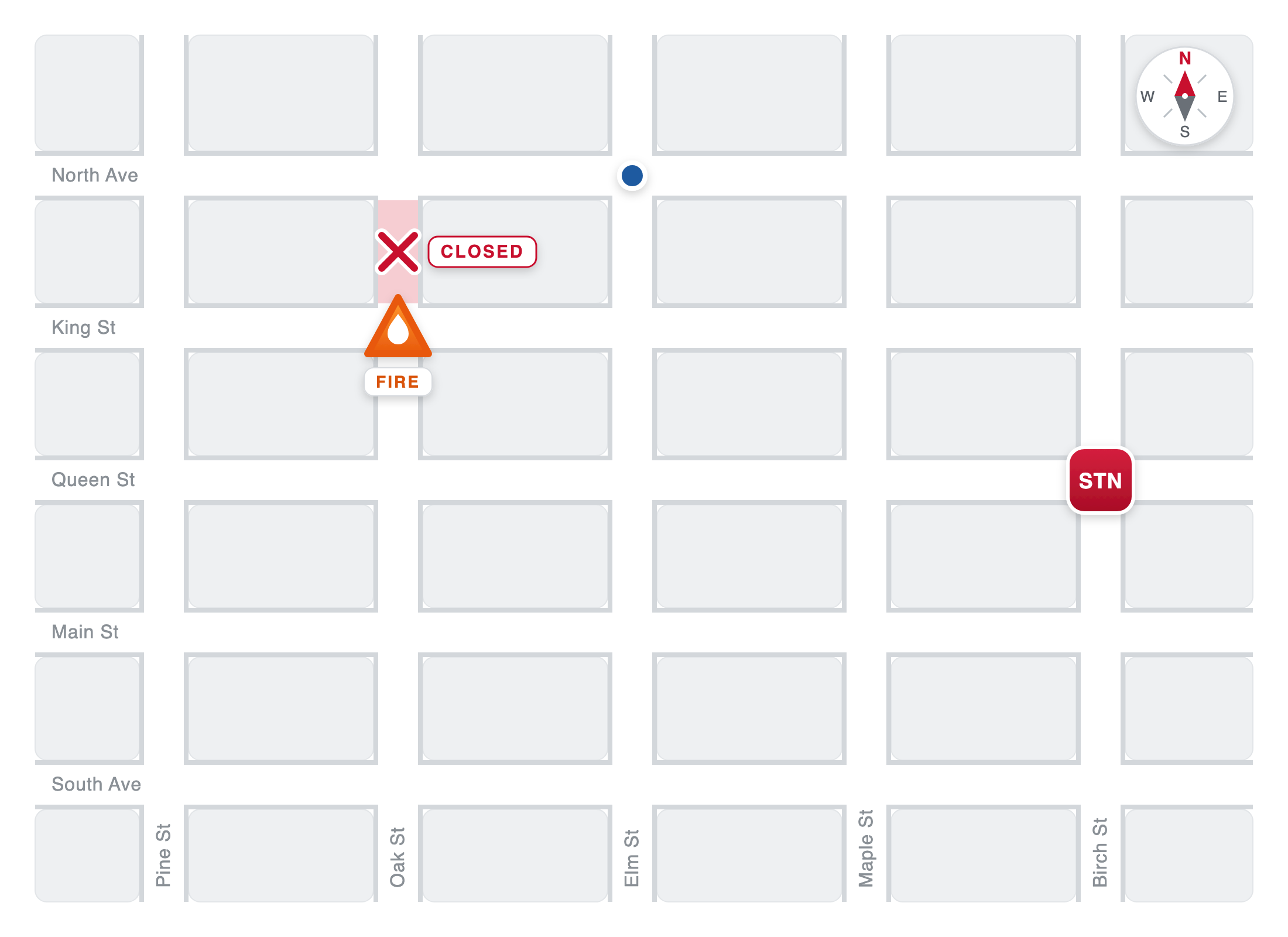
The engine is at Birch St and Queen St (STN); the fire is at Oak St and King St. Oak St is CLOSED between North Ave and King St, and King St is one-way EASTBOUND only. Which approach is valid?
- A. West on Queen St to Oak St, then north on Oak St to King St
- B. West on King St from Birch St directly to Oak St
- C. North on Birch St to North Ave, west to Oak St, then south on Oak St to King St
- D. Both A and C are valid
Show answer & explanation
Answer: A. Route B travels westbound on a one-way eastbound street — not allowed. Route C needs the closed block of Oak St between North Ave and King St. Route A uses open two-way streets and arrives legally.
About this section
- 10 questions (official count per ofai.ca); no per-section time limit is published.
- Tests compass orientation, grid coordinates, shortest-route selection, and relative position logic.
- Many questions reference a printed street map with one-way streets and landmarks.
- Strategy tip: sketch a quick arrow trail on scrap paper as you read each movement — tracking turns in your head is where most errors happen under time pressure.
Train for every FACT section in one place
Canadian-written practice questions covering reading, math, map reading, writing, and character-judgment scenarios — with full explanations for every answer.
4. Writing Ability — 10 questions
Fire reports are legal documents, so the FACT checks whether you can spot correct grammar, punctuation, and spelling. A common format asks you to choose the correctly written version of a sentence:
Sample question — Writing Ability
Choose the version of the radio-log entry that is written correctly.
- A. Pump 3 reported that it’s water supply was secure at 09:15.
- B. Pump 3 reported that its water supply were secure at 09:15.
- C. Pump 3 reported that its water supply was secure, at 09:15.
- D. Pump 3 reported that its water supply was secure at 09:15.
Show answer & explanation
Answer: D. “Its” is the possessive; “it’s” (option A) always means “it is,” which makes no sense here. Option B pairs the singular subject “supply” with the plural verb “were,” and option C inserts an unnecessary comma before the time. Test any “it’s” by expanding it to “it is.”
About this section
- 10 questions (official count per ofai.ca); no separate section timer is published.
- Tests grammar, punctuation, spelling (Canadian conventions), and sentence completion — not essay writing.
- Sentences are drawn from fire-service writing: incident reports, radio logs, memos, public notices.
- Strategy tip: compare the options one difference at a time (spelling, then verb tense, then commas) instead of re-reading each full sentence — the options usually differ in exactly one or two spots.
The Personal Characteristics Section: 60 Questions Worth 55% of Your Result
This is the part of the FACT nobody warns you about. Sixty of the 110 questions — and 55% of the weighting — assess who you are, not what you know. FPSI designed this section to measure the traits fire services say separate good hires from bad ones:
- Teamwork — putting the crew’s effectiveness ahead of personal credit
- Honesty and integrity — owning mistakes, refusing shortcuts on safety and records
- Emotional stability — staying composed under criticism, conflict, and stress
- Commitment — following through on training, standards, and responsibilities
- Professionalism — how you treat the public, superiors, and peers
- Decision-making under stress — sound judgment when the easy option is wrong
OFAI’s official FACT outline confirms the character section’s weighting and traits, but does not specify best/worst pairs or 1–5 response ratings. Our workplace scenarios are independent judgment exercises. Use them to explain why a response protects safety, honesty and teamwork; do not treat their response format or scoring as a reproduction of the FACT. For self-report questions, answer honestly and follow the instructions given on test day.
One honest caution: answer as your genuine best self, consistently. These instruments are built to detect candidates who paint an implausibly perfect picture.
5. Personal Characteristics — sample scenario
This original workplace scenario asks you to choose the MOST effective response and explain your reasoning. It is an independent judgment exercise; the best/worst response format has not been confirmed in OFAI’s public FACT outline.
Original workplace-judgment practice question
Two days after submitting an incident report for a carbon monoxide call, you realize you recorded the wrong unit number for the apartment involved. The report has already been filed and no one has noticed. The mistake could matter if the file is ever pulled for a follow-up inspection or a legal request.
Which response is the MOST effective?
- A. Notify your officer about the error right away and follow the department’s process for correcting the report.
- B. Leave it alone — the call was resolved without injury, so the wrong unit number is unlikely to ever matter.
- C. Log back in and quietly change the unit number yourself without telling anyone the report was altered.
- D. Wait to see whether anyone flags the discrepancy before deciding whether a correction is worth raising.
Show answer & explanation
Answer: A. Incident reports are legal documents, and the correct response to discovering your own error is prompt disclosure through the proper correction process. Self-reporting protects the record’s integrity and demonstrates the accountability the service depends on.
For an additional practice exercise, identify the LEAST effective option: C. Silently altering a filed record hides the mistake instead of correcting it through the proper process. This extra exercise does not describe a verified FACT question format.
About this section
- 60 questions and 55% of your overall result (both official per ofai.ca) — the largest and heaviest section by far.
- Measures teamwork, honesty, integrity, emotional stability, commitment, professionalism, and decision-making under stress.
- Best/worst choices and effectiveness ratings in our practice are independent training formats, not confirmed FACT response formats.
- Strategy tip: before test day, write down the principles behind good answers (lowest-level resolution, prompt disclosure, safety over convenience) — then check every option against the principles instead of your gut alone.
Is There a FACT Pass Mark? Busting the “70%” Myth
You will find prep sites and forums claiming you need “70%” or some other cutoff to pass the FACT. No pass mark has ever been published. OFAI reports your result as pass or fail only — no numeric score is released to you or to departments, and neither OFAI nor FPSI publishes a cutoff. Any specific percentage you read online is guesswork. What that means practically: you cannot bank on acing the aptitude half to carry a weak character half (it is only 45% of the result), and you should treat every one of the 110 questions as if it matters — because you will never see a score breakdown telling you otherwise.
FACT Cost, Booking, Certificate Validity and Retakes
- Cost: $75 + HST, paid when you book through your account at ofai.ca.
- Location: proctored computer lab at FESTI in Mississauga, single sitting, up to 3 hours.
- Results: your certificate (or fail notice) appears in your OFAI account within 3 business days.
- Validity: the Stage One certificate is valid for 24 months — time your test so it covers the recruitment windows you are targeting.
- Retakes: wait 15 days after a first unsuccessful attempt and 30 days after any subsequent attempt. There is no published limit on total attempts, but each one costs the full fee — walking in prepared the first time is the cheap option.
Which Ontario Fire Departments Use the OFAI FACT?
Toronto Fire Services and Ottawa Fire Services officially require OFAI candidate testing certificates on their own recruitment pages (toronto.ca, ottawa.ca). Beyond those two, OFAI lists the departments below as participating in Stage One candidate testing.
See the full department list (33 departments, as of July 2026)
- City of Toronto – Toronto Fire Services
- City of Kitchener – Kitchener Fire Department
- City of North Bay – North Bay Fire & Emergency Services
- GTAA Fire & Emergency Services
- City of Peterborough – Peterborough Fire Services
- City of Brampton – Brampton Fire & Emergency Services
- City of Barrie – Barrie Fire & Emergency Services
- City of Guelph – Guelph Fire Department
- City of Cambridge – Cambridge Fire Department
- City of Woodstock – Woodstock Fire & Rescue
- City of Stratford – Stratford Fire Department
- Town of Oakville – Oakville Fire Department
- Town of East Gwillimbury – East Gwillimbury Emergency Services
- Town of Midland – Midland Fire Department
- Town of Greater Napanee – Greater Napanee Fire Services
- City of Mississauga – Mississauga Fire & Emergency Services
- City of Owen Sound – Owen Sound Fire & Emergency Services
- City of Quinte West – Quinte West Fire & Rescue
- Town of Caledon – Caledon Fire & Emergency Services
- Central York Fire Services
- City of Waterloo – Waterloo Fire & Rescue
- City of Pickering – Pickering Fire Services
- Billy Bishop Toronto City Airport Fire Department
- City of Markham – Markham Fire and Emergency Services
- Township of Scugog – Scugog Fire Service
- City of Sarnia – Sarnia Fire Rescue
- City of Oshawa – Oshawa Fire Services
- City of St. Thomas Fire Department
- Township of Springwater – Fire and Emergency Services
- Loyalist Township – Loyalist Township Emergency Services
- Town of Bradford West Gwillimbury – Bradford West Gwillimbury Fire & Emergency Services
- City of Brockville – Brockville Fire Department
- City of Welland – Welland Fire Services
List current as of July 2026. Department participation changes — always confirm testing requirements on the department’s own recruitment page before booking.
How to Prepare for the OFAI FACT
Plan preparation around both aptitude and character. Review the personal traits described by OFAI and answer self-report questions honestly. Use independent scenario exercises to practise explaining your judgment, then work on arithmetic, reading, maps and writing. Start with our free practice test to identify skills that need more practice.
Not your test?
Ontario and Canadian departments use several different entrance exams. If your target department is not on the OFAI list above, check these guides:
- CPS Firefighter Aptitude Test — used by many Ontario departments via FSO
- FSO Firefighter Testing (often searched as “Gledhill Shaw”) — Windsor, Burlington, Niagara-area departments and more
- NFST Firefighter Test — the FACT’s FPSI sibling, used by Halifax and Vancouver
- FireTEAM Test (NTN) — the video-based exam used by Calgary Fire
Ready to walk into FESTI prepared?
Practise the FACT aptitude skills and work through independent character-judgment exercises with Canadian-written questions and explanations. Includes the FR Study Series — a dedicated OFAI FACT study guide plus 15 more, with lessons and worked examples. Practice formats and scores do not predict your official result.
FAQ
Is there a pass mark on the OFAI FACT? What score do I need?
No pass mark is published. The FACT is reported as pass or fail only — OFAI does not release a numeric score to you or to fire departments, and neither OFAI nor FPSI publishes a cutoff. Claims like “you need 70%” that circulate on prep sites and forums are unofficial guesses. The reliable strategy is to prepare for all five sections, remembering that the Personal Characteristics section alone carries 55% of the weighting.
How long is the FACT certificate valid, and when can I retake the test?
Your OFAI Stage One certificate is valid for 24 months from the test date. If you are unsuccessful, you must wait 15 days before retaking after a first attempt, and 30 days after any subsequent attempt. Each retake requires paying the full fee again, so time your first attempt to cover the recruitment windows you are targeting and prepare thoroughly before booking.
What is the Personal Characteristics section, and why is it 55% of the result?
OFAI describes 60 items covering interpersonal skills, teamwork, commitment, honesty, integrity and emotional stability, with a 55% character weighting. The official outline does not specify best/worst pairs or 1–5 ratings. Our scenario exercises help you discuss workplace judgment; they do not establish the format or scoring of official character questions. Answer self-report items honestly.
How much does the FACT cost, and how do I book it?
The test fee is $75 plus HST. You create an account at ofai.ca, book an available session, and sit the exam at the proctored computer lab at FESTI in Mississauga. Your result — and, if you pass, your Stage One certificate — appears in your OFAI account within 3 business days. Departments verify the certificate through OFAI when you apply.
What to Look For in Any Firefighter Test Prep
Whichever provider you choose — including us — hold it to these six checks before you pay:
- ✓Matches the exact test your department names. FACT, NFST, FSO/CPS and FireTEAM are different exams with different sections — generic “firefighter test” packs waste your prep time. See our overview of every Canadian firefighter aptitude test if you’re not sure which one you face.
- ✓Format fidelity, not just topic coverage. If your exam delivers passages by audio or scenarios by video, text-only practice trains the wrong skill. Look for single-play audio for listening sections and scenario continuity for video-based tests.
- ✓Worked explanations for every question. An answer key tells you what you got wrong; a worked explanation tells you why — that’s where score improvement actually comes from.
- ✓Canadian content and units. Metric distances, Canadian spellings, Canadian department contexts — and pricing clearly labeled in CAD, so there’s no exchange-rate surprise at checkout.
- ✓Access that matches a real recruitment cycle. Canadian hiring processes run months, not weeks. Clear one-time pricing with long access beats short timed windows you may have to re-buy mid-process.
- ✓Facts it can source. Good prep cites the test owner’s official pages, dates its claims, and says so honestly when a number (like a pass mark) simply isn’t published — instead of asserting one.
FACT is a trademark of FPSI (Fire & Police Selection Inc.). firerecruitment.ca is not affiliated with, endorsed by, or connected to FPSI, OFAI, FESTI, or any fire department. Our practice materials simulate the format and skills tested; they are not actual exam questions. Format details verified 2 July 2026 against official sources where available; specifications marked “reported” are not publisher-confirmed. No pass mark is published for the FACT; we make no pass-rate or hiring guarantees.
Testing in B.C.? Many B.C. departments — Surrey, Richmond, Coquitlam, Abbotsford and more — screen through the BL Associates psychometric battery instead. Read our BLA firefighter test guide.