
← Firefighter Aptitude Tests in Canada
FireTEAM Firefighter Test (Ergometrics/NTN): 2026 Canada Prep Guide
The FireTEAM test is the firefighter entrance exam used by National Testing Network (NTN), and it is unlike every other aptitude test on this site: three of its four sections are delivered as video. You watch scenarios, animated machinery and narrated math problems on screen — with no pause and no rewind — and answer as the test moves on without you. If you are applying to Calgary Fire or any NTN department, this guide walks you through each FireTEAM section with a realistic practice question, explains how scoring actually works, and shows you what to train. When you are ready to go deeper, our full Canadian practice bundle covers every section below, or you can start with the free practice test — no email required.
Free video lesson · Under 9 minutes
Watch a free NTN FireTEAM practice lesson
Practise human relations, mechanical reasoning, mental math and reading with original questions and worked explanations. Follow a crew scenario, trace animated gears and levers, predict changing water levels, then try mental calculations and a missing-word reading exercise.
Watch on YouTube (opens a new tab)
Try it before the answer: Pause to make a prediction, then watch the explanation. Pausing is a learning choice for this lesson; FireTEAM human-relations items play without stopping. Practise the math mentally: the official FireTEAM math test does not permit written calculations.
Put the method into practice
Choose one skill to work on next with the FireRecruitment firefighter aptitude practice bundle:
- A dedicated FireTEAM study guide
- Original written recurring-character scenarios and skill drills
- Worked explanations to help you review mistakes
$97 CAD
One payment · 12 months of access · No subscription
This is independent preparation, not actual NTN exam content or a full official test simulation. The bundle’s FireTEAM scenarios are written practice, not a replica of the video exam. FireTEAM and Firefighter Express are different formats; confirm the exam, permitted materials and appointment details in your booking. FireRecruitment.ca is not affiliated with or endorsed by NTN or the test publisher. Preparation does not guarantee a test result or hiring outcome.
What Is the FireTEAM Test?
The ErgoMetrics FireTEAM test is delivered through National Testing Network at NTN testing centres or by virtual proctoring from home. The whole exam runs about two and a half hours on a computer. Four sections:
| Section | Format | Length* |
|---|---|---|
| Human Relations | Video scenarios with recurring characters, in two parts: choose the best action mid-scene, then judge the characters’ behaviour | ~76 questions, 28 scenarios, ~57 min |
| Mechanical | Animated video of an interconnected factory system; questions about how the machinery responds | ~36 questions, ~43 min |
| Math | Video-presented problems solved mentally — no calculator, no scratch paper | ~31 questions, ~25 min |
| Reading | Fill-in-the-blank (cloze) passages drawn from fire-manual-style text | ~27 questions, ~15 min |
*Section structure and formats are confirmed by NTN; the question counts and timings shown are reported figures and are not published by NTN. Total sitting of roughly 2.5 hours is per NTN.
FireTEAM Human Relations: The Video Section That Decides Your Ranking
Human Relations is the section departments care about most — some weight it far more heavily than the other three combined, according to prep-provider reports. You watch a connected story unfold across multiple scenes featuring the same named characters. Part one pauses mid-scene and asks what the best action is right now. Part two comes back after the story ends and asks you to judge and recall how each recurring character behaved. Here is a practice scenario in that style:
Sample question — Human Relations (serial scenario)
Narrative A — Scene 2 of 4. 08:45, medical call. You are FF Park, riding in back; Captain Reyes is in the officer seat reviewing the call notes, and Dumont is driving. Dispatcher Osei transmits an update: “Correction — patient is at 4188 Carding Mill Row, not 4118, and has moved to the lobby.” Nobody acknowledges the transmission. Dumont mutters “I know that block” and signals to turn one street early, toward the original address.
Part one — best action: You are FF Park. The corrected address has not been acknowledged and Dumont is starting the early turn. What do you do NOW?
- A. Say nothing — the captain heard the radio and will correct the driver if it matters.
- B. Immediately say aloud, “Dispatch updated the address — 4188, next block over,” so the whole cab hears it.
- C. Wait until the truck stops at the wrong address, then point out the correction.
- D. Key the radio and ask Osei to repeat the entire dispatch from the beginning.
Show answer & explanation
Answer: B. Safety-critical updates need closed-loop communication: if no one acknowledged it, assume no one processed it and voice it immediately. Assuming someone senior heard is exactly how crews arrive at the wrong address with a patient waiting.
Part two — character judgment (asked after the narrative ends): Based on what you observed in this scene, which statement best describes Dumont’s behaviour?
- A. Dumont confirms new information over the radio before acting on it.
- B. Dumont acts on assumption and personal familiarity rather than on confirmed information.
- C. Dumont defers every driving decision to Captain Reyes.
- D. Dumont relays dispatch updates clearly to the rest of the crew.
Show answer & explanation
Answer: B. Dumont heard (or ignored) the corrected address, muttered “I know that block,” and turned early toward the old address without acknowledging the update — acting on familiarity instead of confirmed information. This is exactly the kind of behavioural pattern the FireTEAM’s part-two questions ask you to recall and judge.
In the full practice pack, this is one scene of four. The narrative follows FF Park, Captain Reyes, Dumont and dispatcher Osei across all four scenes, then asks you to judge each character’s behaviour afterward — the same two-part mechanic the FireTEAM Human Relations video uses.
About this section
- Tests teamwork judgment, communication under pressure, and your ability to observe and recall how specific people behave over time.
- Reported by prep providers as roughly 76 questions across 28 scenarios in about 57 minutes; NTN confirms the two-part video structure but publishes no counts.
- The video plays once — no pause, no rewind — so you answer while tracking an ongoing story.
- Some departments reportedly weight Human Relations up to around 70% of the total score.
- Strategy tip: attach each character’s name to one defining trait the first time they appear (“Dumont cuts corners”) — the part-two judgment questions reward candidates who tracked people, not just events.
FireTEAM Mechanical Section: System Logic, Not Memorized Formulas
The mechanical section uses an animated video of a factory full of interconnected machinery — belts, valves, tanks, pressure lines — and asks how the system responds when something changes. It rewards cause-and-effect reasoning about flow, pressure and rotation rather than textbook definitions:
Sample question — Mechanical (system behaviour)
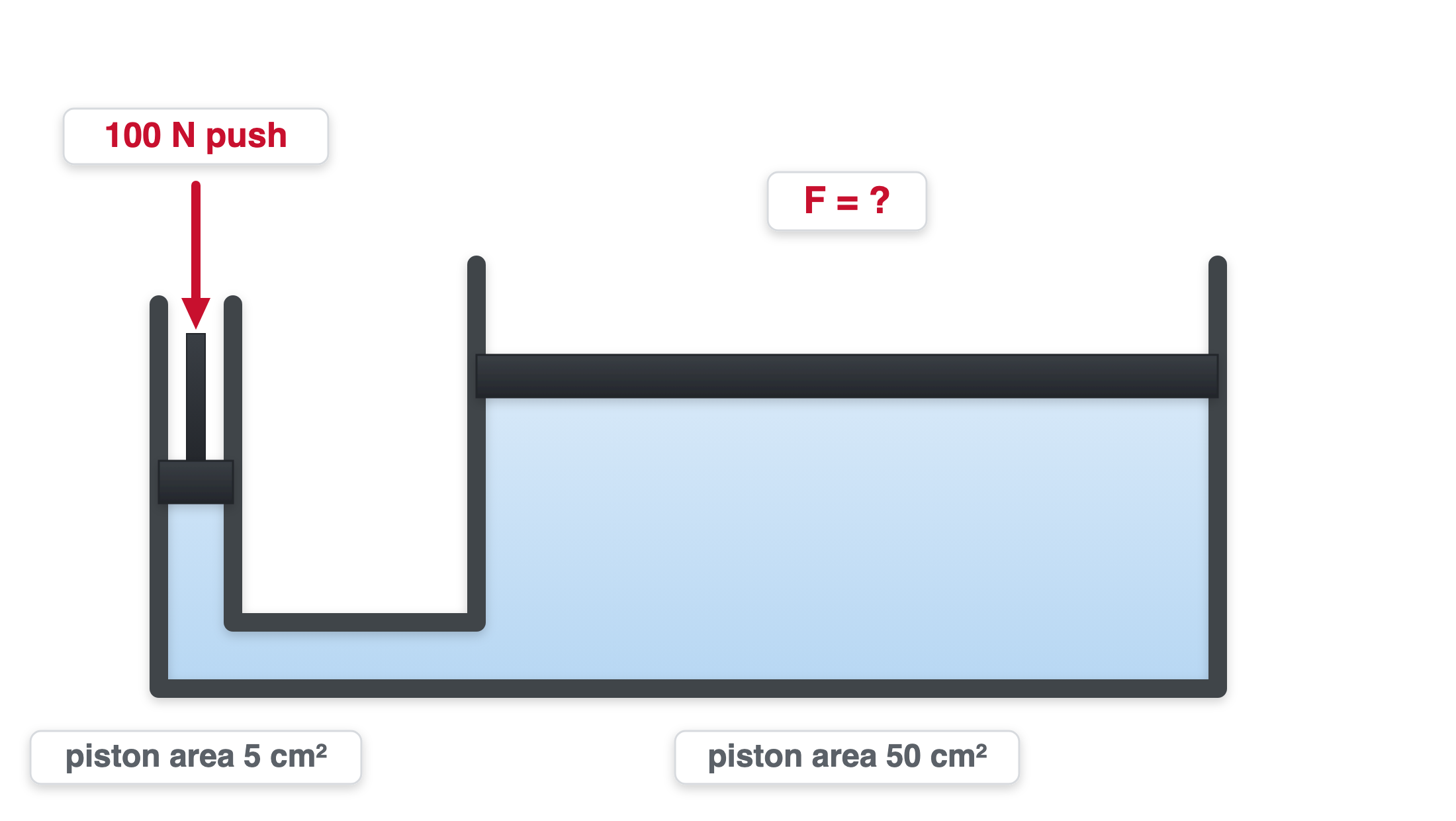
A hydraulic system uses an incompressible fluid. A small input piston has an area of 5 cm² and a large output piston has an area of 50 cm². If a firefighter presses the small piston with 100 N, what force can the large piston deliver?
- A. 1000 N
- B. 100 N
- C. 10 N
- D. 500 N
Show answer & explanation
Answer: A. Hydraulics multiply force by area ratio (Pascal’s principle). Output force = input force × (output area ÷ input area) = 100 × (50 ÷ 5) = 100 × 10 = 1000 N.
About this section
- Tests intuitive understanding of pressure, fluid flow, valves, gears and how connected machinery reacts to a change at one point.
- Reported by prep providers as about 36 questions in roughly 43 minutes; NTN confirms the animated-video format but publishes no counts.
- The animation shows the system once and moves on — you cannot replay a segment you missed.
- Strategy tip: while the animation plays, narrate the chain to yourself (“valve closes → pressure builds upstream → tank fills faster”). Questions almost always probe one link in that chain.
Practice the way the FireTEAM actually tests
Serial-character scenario packs, system-logic mechanical drills, no-scratch-paper mental math and cloze reading — all Canadian-authored and built around the real section formats.
FireTEAM Math: Mental Arithmetic With No Scratch Paper
FireTEAM math problems are presented on video and must be solved entirely in your head — no calculator and no scratch paper are permitted. The arithmetic itself is not advanced; the challenge is holding the numbers while the clock runs:
Sample question — Math (mental calculation)
A pumper travels 18 km to a scene at an average speed of 54 km/h. How many minutes does the trip take?
- A. 15 minutes
- B. 20 minutes
- C. 25 minutes
- D. 18 minutes
Show answer & explanation
Answer: B. Time equals distance divided by speed: 18 divided by 54 equals 1/3 hour, which is 20 minutes.
About this section
- Tests arithmetic, ratios, rates and time/distance reasoning in fire-service contexts — all computed mentally.
- Reported by prep providers as about 31 questions in roughly 25 minutes; NTN confirms the video-presented, mental-only format but publishes no counts.
- No calculator and no scratch paper — a rule most other Canadian fire aptitude tests do not share, so train for it deliberately.
- Strategy tip: convert to friendly fractions before multiplying (18/54 = 1/3) instead of long-dividing in your head — the answer options are usually spaced far enough apart to reward the shortcut.
FireTEAM Reading Test: Fill-in-the-Blank From Fire Manuals
Reading is the one traditional on-screen text section, but it is not standard multiple-choice comprehension. You read passages written in the style of fire-service manuals with words removed, and pick the word that best completes each blank (a cloze format):
Sample question — Reading (cloze)
Instructors at the training tower describe the most dangerous moment of interior firefighting: as a room fire grows, heat radiating downward from the gas layer raises the temperature of every exposed surface until all combustible contents in the compartment ignite almost simultaneously. This transition, known as ____, can occur within seconds and is rarely survivable, even in full protective equipment. Recognizing warning signs such as rapidly building heat and rollover in the smoke layer allows crews to withdraw in time.
Which word best completes the blank?
- A. flashover
- B. backdraft
- C. rollover
- D. rekindle
Show answer & explanation
Answer: A. The passage defines the event as all contents igniting almost simultaneously, which is flashover. “Rollover” is named separately in the passage as a warning sign, a backdraft is an explosion caused by introducing air into an oxygen-starved space, and a rekindle happens after a fire is thought to be out.
About this section
- Tests vocabulary in context and whether you can follow the logic of technical fire-service prose — no prior firefighting knowledge is required; every answer is supported by the passage.
- Reported by prep providers as about 27 questions in roughly 15 minutes; NTN confirms the fill-in-the-blank format but publishes no counts.
- The reported pace is the fastest of the four sections — roughly half a minute per blank.
- Strategy tip: read the full sentence past the blank before choosing; the disqualifying clue for a tempting distractor usually sits after the gap, as it does here with “rollover.”
FireTEAM Practice: Why the Video Format Changes How You Should Prepare
Here is the reality most candidates discover too late: three of the four FireTEAM sections are video-based, and the video plays once. You cannot pause to think, rewind a scene you half-caught, or re-read a math problem. The Human Relations section compounds this by building its hardest questions on top of memory — part two asks you to judge characters based on scenes you watched many minutes earlier.
Most prep products substitute unrelated written questions for this — a stack of standalone situational-judgment items with no connection to each other — which trains the judgment but not the mechanic. Ours rebuilds the recurring-character mechanic itself: connected multi-scene narratives that follow the same named crew members, interrupt you mid-scene for best-action decisions, and then circle back to test what you observed about each person. That is the skill the FireTEAM actually scores, and it is trainable. If you are retesting to beat a competitive percentile, targeted one-on-one tutoring can also focus your limited retest window on the section that is dragging your ranking down.
Which Fire Departments Use the FireTEAM Test in Canada?
Prep providers report that over 150 departments across the US and Canada use the NTN firefighter test, but NTN’s portal does not publish a verifiable Canadian list. The confirmed Canadian user that matters most to candidates is Calgary:
Canadian departments using NTN / FireTEAM (as of July 2026)
Calgary Fire Department (AB) — verified on calgary.ca: two-part NTN exam (FireTEAM plus a second component), $65 USD fee, virtually proctored, applications accepted June 1–30 each year.
Other western-Canadian departments are reported by prep providers to use NTN, but we list only departments we have verified against official sources. Always confirm the current testing requirement on the department’s own recruitment page before booking.
FAQ
What happens in the video Human Relations section — and can I pause it?
No, you cannot pause, rewind or replay the video. You watch scenarios featuring recurring characters; the video stops at decision points and asks which action is best, then a second part asks you to judge and recall how those same characters behaved across the scenes. Because everything plays once, active watching — tracking who did what — matters as much as good judgment. The no-pause rule is reported by prep providers and is consistent with NTN’s own candidate instructions.
What score do I need to pass the FireTEAM test?
There is no universal pass mark. Each department sets its own cut scores for each section, and beyond the cut you are competing on percentile ranking against every other candidate on that department’s list. Prep providers report that scoring around the 70th percentile or higher is typically competitive and that some departments weight Human Relations most heavily, but none of those figures are published by NTN — check the specific department’s posting for its requirements.
How does Calgary Fire use the FireTEAM test?
Calgary Fire Department recruits through National Testing Network with a two-part exam: the FireTEAM test plus a second component. The fee is $65 USD, the exam is virtually proctored so you can write it from home, and Calgary accepts applications during an annual June 1–30 window. Details are confirmed on calgary.ca; verify the current cycle before applying, as windows and fees can change.
How long are FireTEAM scores valid, and when can I retest?
Per NTN’s FAQ, scores are valid for 12 months and you must wait 3 months between attempts. Critically, retesting deletes your previous scores — you cannot keep the better result. That makes retesting a genuine strategic decision: if you scored well in three sections and weak in one, a retest puts all four back on the line. Retest only when you have trained enough to be confident of beating your entire previous performance, not just the weak section.
Not your test?
Departments across Canada use different exams. If you are applying elsewhere, see our guides to the OFAI FACT test (Ontario, incl. Toronto and Ottawa), the FSO CPS aptitude test, the CPS firefighter test, and the NFST firefighter test.
Ready to train for the FireTEAM?
Serial-character Human Relations narratives, system-logic mechanical drills, mental-math sets and cloze reading passages — built by Canadian authors around the formats above. Includes the FR Study Series — a dedicated FireTEAM study guide plus 15 more, with lessons and worked examples.
Or start with the free FireTEAM practice test — no email required.
What to Look For in Any Firefighter Test Prep
Whichever provider you choose — including us — hold it to these six checks before you pay:
- ✓Matches the exact test your department names. FACT, NFST, FSO/CPS and FireTEAM are different exams with different sections — generic “firefighter test” packs waste your prep time. See our overview of every Canadian firefighter aptitude test if you’re not sure which one you face.
- ✓Format fidelity, not just topic coverage. If your exam delivers passages by audio or scenarios by video, text-only practice trains the wrong skill. Look for single-play audio for listening sections and scenario continuity for video-based tests.
- ✓Worked explanations for every question. An answer key tells you what you got wrong; a worked explanation tells you why — that’s where score improvement actually comes from.
- ✓Canadian content and units. Metric distances, Canadian spellings, Canadian department contexts — and pricing clearly labeled in CAD, so there’s no exchange-rate surprise at checkout.
- ✓Access that matches a real recruitment cycle. Canadian hiring processes run months, not weeks. Clear one-time pricing with long access beats short timed windows you may have to re-buy mid-process.
- ✓Facts it can source. Good prep cites the test owner’s official pages, dates its claims, and says so honestly when a number (like a pass mark) simply isn’t published — instead of asserting one.
FireTEAM is a trademark of ErgoMetrics & Applied Personnel Research, Inc.; National Testing Network (NTN) is a trademark of its respective owner. firerecruitment.ca is not affiliated with, endorsed by, or connected to ErgoMetrics, National Testing Network, the Calgary Fire Department, or any fire department. Our practice materials simulate the format and skills tested; they are not actual exam questions and contain no NTN video or footage. Question counts, timings and scoring figures marked “reported” are not publisher-confirmed. Each department sets its own passing standards; we make no pass-rate or hiring guarantees. Format details verified 2 July 2026 against official sources where available.
Testing in B.C.? Many B.C. departments — Surrey, Richmond, Coquitlam, Abbotsford and more — screen through the BL Associates psychometric battery instead. Read our BLA firefighter test guide.