
← Firefighter Aptitude Tests in Canada
BLA Firefighter Test (B&L Associates): Format, Departments & Free Practice Questions
The BLA firefighter test — administered by BL Associates Corporate Psychologists Inc. of Vancouver — is the written stage at more than a dozen B.C. fire departments. Surrey, Richmond, Coquitlam, Abbotsford, Langley City, Port Moody, Saanich and Oak Bay all screen candidates through it, and BLA’s score-transfer program reaches as far as Fredericton, New Brunswick. Unlike Ontario’s OFAI FACT or the CPS exam, it isn’t a conventional multiple-choice aptitude test with a published question count: it’s a psychometric battery — a series of separate questionnaires measuring how you think and who you are, completed in one sitting of up to 3.5 hours.
This guide covers the published format, which departments use it (and what each one calls it), what it costs, how score transfers work, and how to prepare — with free BLA-style sample questions along the way.
One test, several names — make sure you recognize it in your posting
BLA’s clients each brand the stage their own way, which trips up candidates applying to more than one department. All of the following refer to the same BL Associates battery:
- Surrey Fire Service — “Psychometric Screen (Written Exam)”, Stage 4 of its process
- Richmond Fire-Rescue — “Written Testing: Personal-Competency Assessment for the Job of Firefighter”
- Coquitlam Fire/Rescue — “Firefighter Competency Test through BL Associates”
- Abbotsford Fire Rescue Service — “Written Assessment — BL Associates Firefighter Competency Assessment”
- Port Moody Fire Rescue — “Psychometric evaluation”
If your posting says any of the above — or simply “psychometric testing” at a B.C. department — this is the test to prepare for. Always confirm against the current posting: departments do change providers (Abbotsford, for example, used FPSI’s NFST until around 2021 before moving to BLA).
What’s on the BLA test: timed problem-solving, then character & interest
Per BLA’s own candidate information pack, you complete 5–6 separate questionnaires depending on the municipality, inside a session capped at 3.5 hours. The battery has two distinct halves, always in this order:
1. Timed problem-solving questionnaires — time limits of 5 to 25 minutes each — measuring four intellect areas:
- Verbal — reading, writing and language fluency. BLA’s own published sample is a spelling item: pick the pair of words that completes a sentence with both words spelled correctly.
- Mathematical — computation: percents, equivalent expressions, and word problems you set up as a simple equation. BLA’s published sample problems are all workable by hand.
- Reasoning — logic without prior knowledge: day-of-week puzzles, finishing-order puzzles, and the formats BLA itself tells candidates to practise — “symbolic reasoning, abstract reasoning, and syllogisms.”
- Mechanical — how mechanical systems behave: gears, pulleys, pendulums, force and motion. BLA’s published examples are a gear-rotation question and a pendulum-speed question.
2. Untimed character & interest questionnaires — 30–40 minutes each in practice — made of short first-person statements answered true or false. BLA’s published competency model groups these into character traits (responsibility, teamwork, desire to learn, getting along with others, stress resistance, courage, activity, cleanliness and socialization) plus two work-interest areas (construction and medical). BLA also notes its firefighter profiles now carry three special indicators: stress resistance, leadership potential and counterproductive workplace behaviour.
Two things BLA is explicit about: the test does not require any firefighting knowledge — it screens for the ability to learn the job, not familiarity with it — and the problem-solving skills it measures can be improved with practice. Their info pack says the timed questionnaires “measure thinking skills that can be improved through effort and practice.” That’s the entire case for preparing.
Session logistics and fees: what to expect on test day
The test runs two ways, and your department’s posting decides which you get:
- In person — paper-and-pencil, in groups of up to 150 candidates, with all materials supplied. BLA’s candidate pack says most candidates finish in about 3 hours. There are no scheduled breaks; once you’re onto the untimed character questionnaires you may leave the room and return, but everything must be handed in within the session window. Surrey runs its testing in-person only.
- Online — the same battery, remotely proctored over videoconference. You need stable internet, a webcam and a microphone; a live proctor verifies your ID and that your room is clear of people and resources. BLA’s candidate pack says most candidates finish the online sitting in about 2.5 hours. Richmond, Abbotsford and the Saanich/Oak Bay joint recruitment have all run online sittings.
The fee is yours to pay, and it isn’t small. Recent verified figures: Richmond’s 2026 process charged $400 (online, non-refundable, paid at registration); Coquitlam’s manual lists $340 plus tax; Surrey’s 2024 sittings were $360 per seat; the 2025 Saanich & Oak Bay guide lists $415 plus GST. BLA’s own payment portal currently lists $400 for the online test and $370 in person, plus GST. Some departments (Coquitlam, for one) offer case-by-case financial subsidies — ask rather than assume. Between the fee and the once-per-cycle sitting, walking in unprepared is an expensive way to find out what the test feels like.
Score transfers: one sitting can cover several departments
BLA runs a score-transfer program between enrolled departments. The published rules:
- Scores must have been earned within the 12 months before the new competition.
- They must meet the receiving department’s own minimum — a pass at one department does not guarantee a pass at another, because each municipality sets its own criteria.
- Expect a minimum of about 21 calendar days between competitions for a transfer to be practical, and submit transfer requests at least 3 business days before the new competition.
- The transfer itself costs money — BLA’s portal lists $110 (plus GST); Coquitlam quotes $115.50 to send a result in.
Twelve departments are currently enrolled: Abbotsford, Coquitlam, Fort St. John, Fredericton, Kootenay Boundary, Langley City, Nanaimo, Oak Bay, Port Moody, Prince George, Richmond and Surrey. If you’re applying to several B.C. departments in one year, one strong sitting can carry you across all of them — which raises the stakes of that one sitting even further.
Langley City note: LCFRS currently runs two written screens — an Ergometrics FireTEAM online test and the in-person BLA competency test. If Langley City is on your list, prepare for both formats: our FireTEAM guide covers the other half.
Free BLA-style practice questions
These are original questions in the style of BLA’s published examples — one per intellect area. (Nobody outside BL Associates has real test items; anyone claiming to sell them is not being straight with you.)
Verbal — spelling pair
Select the option in which BOTH words are spelled correctly: “The hotel could not provide ——– for the entire ——–.”
- A. accomodation … committee
- B. accommodation … committee
- C. accommodation … comittee
- D. accomodation … comittee
Show answer & explanation
Answer: B. Accommodation needs a double C and a double M — think “two cots need two mattresses.” Committee doubles the M, the T and the E. The wrong options each drop one of these doubled letters.
Mathematical — two-step percent
A jacket priced at $80 is marked up 25 percent. A month later it is sold at 10 percent off the new price. What does it sell for?
- A. $88
- B. $90
- C. $92
- D. $95
- E. $100
Show answer & explanation
Answer: B. The markup takes the price to $80 × 1.25 = $100. The discount then applies to the NEW price: $100 × 0.90 = $90. Successive percentages don’t simply add or subtract — each applies to a different base, so 25% up then 10% off is not “15% up” ($92 is the trap answer).
Reasoning — ordering puzzle
Four people wait in a single line at a bakery: Mia, Jake, Noor, and Theo. Theo is first. Jake stands immediately behind Mia. Noor is not last. Who is third in line?
- A. Noor
- B. Jake
- C. Theo
- D. Mia
Show answer & explanation
Answer: D. Theo is first. Mia-then-Jake must sit together, so they occupy either positions 2–3 or 3–4. If Mia took 2 and Jake 3, Noor would be last — which the clues forbid. So Noor is second, Mia third, Jake fourth. This is the same style as BLA’s published “finishing order” example: chain the clues, eliminate the impossible arrangement.
Mechanical — gear rotation
Three gears are meshed in a row: gear A turns gear B, and gear B turns gear C. If gear A turns clockwise, which way does gear C turn?
- A. Clockwise
- B. Counter-clockwise
- C. It alternates direction
- D. It does not turn
Show answer & explanation
Answer: A. Meshed gears reverse direction at every contact: A clockwise drives B counter-clockwise, and B drives C clockwise again. Shortcut worth memorizing: in a chain of meshed gears, the odd-numbered gears all turn one way and the even-numbered gears the other.
Bonus: mechanical with a diagram — lever advantage
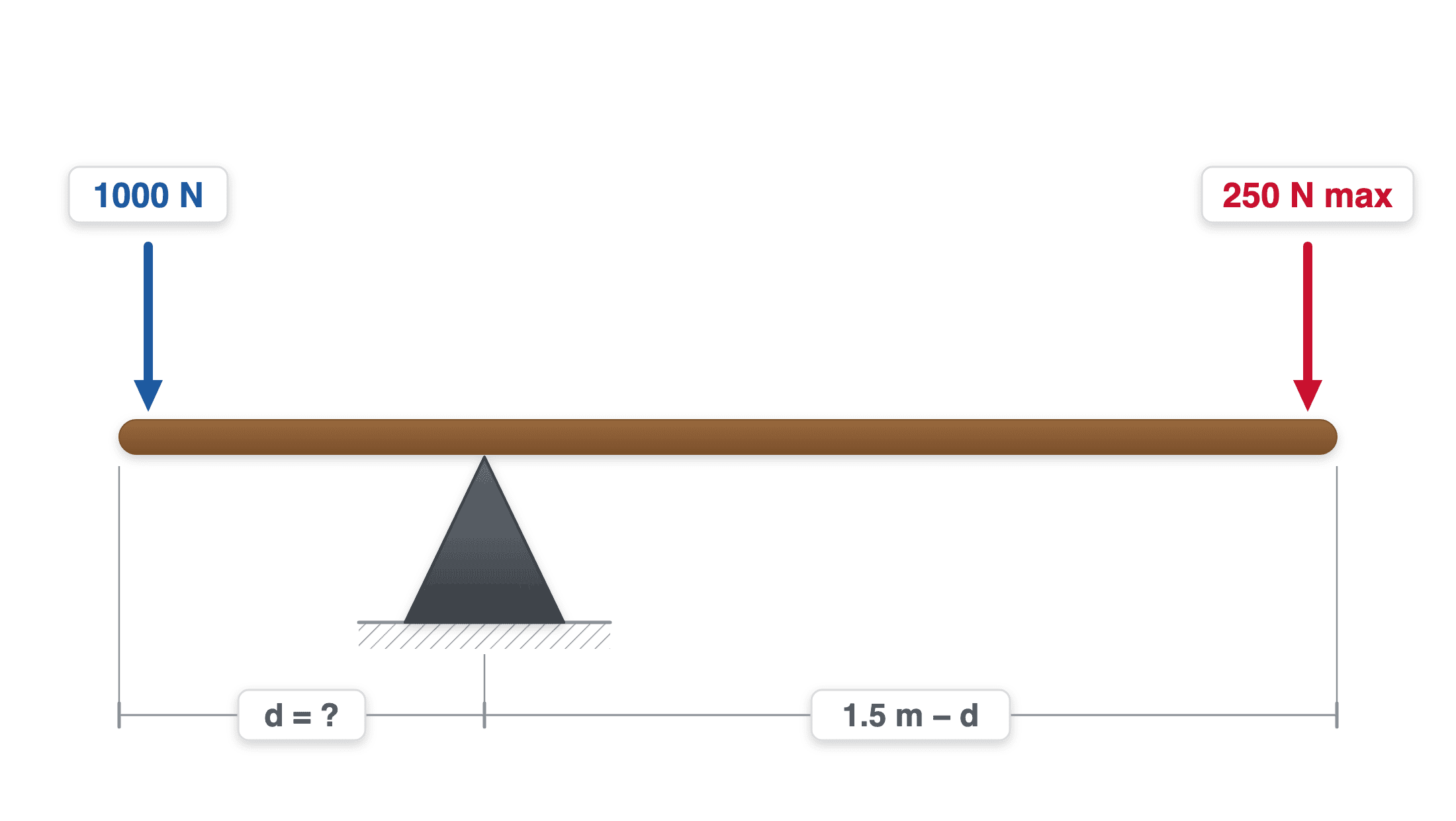
A firefighter can push down with a maximum force of 250 N on the end of a 1.5 m pry bar. She needs to lift a 1000 N manhole cover. What is the maximum distance the fulcrum can be from the load and still let her lift it, assuming she pushes at the far end?
- A. 0.30 m
- B. 0.375 m
- C. 0.60 m
- D. 1.2 m
Show answer & explanation
Answer: A. Let the load arm be d, so the effort arm is 1.5 − d. She needs 250 × (1.5 − d) ≥ 1000 × d, which gives 375 = 1250d, so d = 0.30 m. Any farther from the load and the leverage isn’t enough.
The character & interest inventory: answer honestly — BLA says so itself
The untimed half of the battery is a long run of true/false statements about everyday behaviour and preferences — in the same spirit as these two illustrations (ours, not BLA’s):
- “I keep my workspace neat and organized.” — the kind of statement that taps orderliness/cleanliness.
- “I would rather spend a Saturday building something than watching TV.” — the kind that taps construction interest.
The most important preparation advice comes from BLA directly: answer honestly. Their candidate pack warns that answering the way you think a firefighter would answer is a losing strategy — candidates who do it “tend to receive lower scores than candidates who respond in accord with how they really feel.” Personality inventories are built to detect impression management. What practice CAN legitimately do is make the format familiar, show you how statements map to the published competencies, and take the anxiety out of the untimed half — so you spend your energy where it pays: the timed questionnaires.
How to prepare for the BLA test
BLA’s own advice, straight from the info pack: sleep well the two nights before, eat a substantial meal within two hours of the session, get some exercise that morning, and keep the day before low-stress — because the timed questionnaires are “susceptible to fatigue effects” and the session demands the concentration of a full workday. Then, for the trainable half:
- Practise each intellect area under its own clock. The real questionnaires run 5–25 minutes each; pacing is a skill you build, not a talent.
- Drill the exact formats. Spelling pairs, two-step percents, syllogisms, day-of-week puzzles, gear trains and pendulums — the styles above repeat.
- Train the gear-shift. The battery jumps from words to numbers to logic to machinery in one sitting. Mixed timed practice builds exactly that.
Our aptitude practice bundle ($97 CAD, one-time, 365 days) includes a dedicated BC Psychometric (BLA-Style) Practice Set — plus a dedicated BLA-style study guide from the 16-guide FR Study Series — built to the published format: four timed problem-solving questionnaires (verbal · 15 min, mathematical · 25 min, reasoning · 20 min, mechanical · 15 min), a 110-statement true/false character & interest inventory mapped to the published competency model, and a 10-minute rapid mixed drill for the fatigue factor — every question original, every answer explained. There’s also a free 15-question practice test to benchmark yourself first.
FAQ
How many questions are on the BLA firefighter test?
BLA doesn’t publish question counts, and no reliable public source reports them. What IS published: 5–6 separate questionnaires, timed problem-solving sections of 5–25 minutes each, and untimed character questionnaires of roughly 30–40 minutes each, inside a 3.5-hour session. Treat any site quoting an exact question count with suspicion.
What is a passing score on the BLA test?
There isn’t a universal one. Each municipality sets its own criteria, and Surrey’s recruitment page notes explicitly that a passing score elsewhere doesn’t guarantee a pass in Surrey. Candidates are told whether they’re moving forward; detailed scores aren’t shared automatically, though BLA lets candidates book a short score-feedback session once a department has notified them of their status.
How much does the BLA test cost?
The candidate pays, and recent verified figures run $340–$415 depending on the department and format: Richmond charged $400 (online, 2026), Coquitlam lists $340 plus tax, Surrey’s 2024 sittings were $360, and Saanich/Oak Bay’s 2025 guide lists $415 plus GST. Transfers of an existing score cost about $110–$115.
Can I reuse my BLA score at another department?
Yes, if both departments are enrolled in BLA’s score-transfer program, your score is less than 12 months old, and it clears the receiving department’s threshold. Twelve departments are enrolled as of July 2026, including Surrey, Richmond, Coquitlam, Abbotsford and Fredericton. Request the transfer at least three business days before the new competition.
Is the BLA test the same as the OFAI FACT or CPS test?
No. The FACT (Ontario, via OFAI) and CPS exam (Firefighter Services of Ontario) are conventional multiple-choice aptitude exams; the BLA battery is a proprietary psychometric assessment combining timed ability questionnaires with true/false personality inventories. The underlying skills overlap — math, verbal, reasoning, mechanical — but the format and the character half are distinct.
Can you fail the personality part?
Municipalities use the character and interest results as part of their selection decision, so yes — they matter. But they aren’t a quiz you can cram for. BLA’s own guidance is to reflect on your genuine qualities and answer honestly, because trying to answer “like a firefighter would” tends to lower scores rather than raise them.
What to Look For in Any Firefighter Test Prep
Whichever provider you choose — including us — hold it to these checks before you pay:
- ✓Matches the exact test your department names. The BLA battery, FACT, NFST, CPS and FireTEAM are different instruments — generic “firefighter test” packs waste your prep time. See our overview of every Canadian firefighter aptitude test if you’re not sure which one you face.
- ✓Honesty about what nobody has. BLA’s instrument is proprietary and question counts aren’t published. Prep that quotes exact counts or claims “real BLA questions” is guessing at best.
- ✓Timed section-by-section practice. The BLA format is separate clocked questionnaires — practice should run the same way, not as one untimed question dump.
- ✓Worked explanations for every question. An answer key tells you what you got wrong; a worked explanation tells you why — that’s where score improvement comes from.
- ✓Canadian content, CAD pricing, cycle-length access. B.C. hiring processes run months; clear one-time CAD pricing with long access beats short expiring licenses.
- ✓Ethical handling of the personality half. Good prep teaches the format and tells you to answer honestly — it never sells “the right answers” to a character inventory.
Testing outside B.C. too? Read the guide for your other exam: OFAI FACT (Ontario), CPS firefighter test, NFST (Halifax/Vancouver), FireTEAM/NTN, or the FSO firefighter test — or compare them all in the department-by-department directory.
The Firefighter Competency Test / psychometric screen described on this page is administered by BL Associates Corporate Psychologists Inc. firerecruitment.ca is not affiliated with, endorsed by, or connected to BL Associates, Surrey Fire Service, Richmond Fire-Rescue, or any fire department. Our practice materials are original questions that simulate the published format and skills tested; they are not actual exam questions. Format, fee and department details on this page were verified July 2026 against BL Associates’ published candidate materials and the departments’ own recruitment documents; fees and processes change — always confirm against your current posting.