
← Firefighter Aptitude Tests in Canada
NFST (National Fire Select Test): Format, Free Practice Questions & the Vancouver NFST-CFT
The NFST firefighter test — FPSI’s National Fire Select Test — is the written entrance exam behind firefighter hiring in Halifax and, in its NFST-CFT variant, Vancouver. It comes in two parts: a general aptitude test built on six constructs, and a personality inventory. Together, human relations and personality count for 55% of your result — more than all the cognitive sections combined. This guide walks through every section with free sample questions in the NFST style, gives you the honest answer on question counts (FPSI doesn’t publish them), and explains exactly how Halifax and Vancouver use the test. When you’re ready for full timed simulations, our Canadian-built NFST practice test bundle covers every section.
Not sure where you stand? Take our free firefighter aptitude practice test — instant results, no email required.
NFST quick facts
- Publisher: Fire & Police Selection, Inc. (FPSI) — not IPMA-HR, not Stanard & Associates, not IO Solutions
- Structure: two parts — general aptitude test + personality inventory (FPSI)
- Weighting: 45% cognitive / 55% human relations + personality (FPSI)
- Format: multiple choice with 4–5 options per item; number-correct scoring, no guessing penalty (FPSI)
- Question count & time limit: not published by FPSI — announced on test day. Prep-company figures (“~100 questions / 2–2.5 hours / 70% pass”) are unverified claims.
- Canadian users: Halifax Regional Fire & Emergency (FPSI online test) and Vancouver Fire Rescue Services (NFST-CFT), as of July 2026
Three different tests called “NFST” — make sure you study the right one
Search “NFST” and you’ll find three unrelated exams with confusingly similar names:
- FPSI’s National Fire Select Test — the exam this page covers, used by Halifax and (as NFST-CFT) Vancouver.
- Stanard & Associates’ National Firefighter Selection Test — a US-only exam covering reading, math, and listening. Different publisher, different content.
- IO Solutions’ NFSI — another US firefighter exam, again from a different publisher.
One more sibling worth knowing: Ontario’s FACT (administered by OFAI) is also published by FPSI and tests the same construct family — but it’s a different exam. If your posting is in Ontario, read our OFAI FACT guide instead. Always match the exact test name in your department’s recruitment posting before you buy any prep material.
What’s on the National Fire Select Test: the six aptitude constructs
FPSI confirms six constructs on the general aptitude portion:
- Reading — a one-page fire-service passage followed by 5 multiple-choice questions
- Math Reasoning — word problems and applied arithmetic, no calculator allowed
- Map Reading — grids, compass directions, and routes
- Writing Ability — grammar, punctuation, and sentence construction (we cover this format in depth on the FACT page — same skill, same publisher)
- Human Relations — scenario judgment questions about crew conflict, integrity, and public interaction
- Reasoning Skills — a mixed section including mechanical reasoning, spatial rotation, and vocabulary items
The second part of the exam is a personality inventory — there is no official practice version of it, and we explain what to do about that in the FAQ below.
NFST scoring: why the 45/55 split should change how you study
FPSI weights the NFST 45% cognitive, 55% human relations plus personality. Read that again: the sections most candidates practise hardest — math, reading, maps — together count for less than half of your result. The human-relations judgment questions and the personality inventory carry more weight than everything else combined.
That’s why the most valuable practice you can do is scenario judgment: learning the fire-service norms for handling crew conflict, chain of command, integrity dilemmas, and angry members of the public. If interpersonal judgment is the part you’re least sure about, our one-on-one tutoring spends most of its time exactly there. Scoring is number-correct with no guessing penalty (FPSI), so on test day, answer every single question.
Free NFST practice questions, section by section
Each sample below is an original question from our Canadian practice bank, written in the NFST format. These are not actual exam questions.
1. Reading — one passage, questions that test sequence and detail
INCIDENT NARRATIVE — RESIDENTIAL STRUCTURE FIRE, MAPLE STREET
At 02:14, Engine 7 was dispatched to a reported house fire on Maple Street. Captain Diaz arrived first and reported smoke showing from the second floor of a two-storey wood-frame home. A neighbour on the lawn told the captain that an elderly resident, Mr. Byrne, used a bedroom at the rear of the house and might still be inside.
Captain Diaz ordered a primary search while the crew stretched a hose line through the front door. Firefighter Nowak located Mr. Byrne in the rear bedroom, disoriented but conscious, and guided him to the front lawn where paramedics took over. Meanwhile, the hose crew advanced to the base of the stairs but found the fire had extended into the ceiling.
Recognizing the risk of the fire spreading through the attic, Captain Diaz requested a second engine and ordered the roof to be opened for vertical ventilation. Once the roof was cut, heat and smoke lifted noticeably, and the interior crew was able to knock down the main body of fire within eight minutes. Overhaul revealed the fire had started in a space heater left running near curtains. No firefighters were injured, and Mr. Byrne was treated for smoke inhalation and released. Captain Diaz noted in her report that the neighbour’s information was critical to the rescue.
In what order did the following events occur?
- A. Roof cut for ventilation → primary search ordered → Mr. Byrne rescued
- B. Primary search ordered → roof cut for ventilation → main fire knocked down
- C. Main fire knocked down → primary search ordered → roof cut for ventilation
- D. Mr. Byrne rescued → primary search ordered → second engine requested
Show answer & explanation
Answer: B. The narrative sequence is: Captain Diaz ordered a primary search, then after finding fire in the ceiling ordered the roof cut for vertical ventilation, after which the interior crew knocked down the main body of fire.
About this section
- FPSI confirms the format: a one-page fire-service passage followed by 5 multiple-choice questions.
- Expect main-idea, specific-detail, sequence-of-events, inference, and vocabulary-in-context questions.
- FPSI does not publish a per-section count or time limit — totals are announced on test day.
- Strategy: read the five questions before the passage. Detail and order questions can then be answered by scanning back to the exact sentence instead of re-reading everything.
2. Math Reasoning — no calculator allowed
A pumper flows 900 L/min from a 2,700 L booster tank. With no external supply, how long until the tank is empty?
- A. 3 minutes
- B. 2.5 minutes
- C. 4 minutes
- D. 3.5 minutes
Show answer & explanation
Answer: A. Tank volume divided by flow rate: 2,700 L divided by 900 L/min equals 3 minutes.
About this section
- Covers applied arithmetic: percentages, ratios, flow rates, unit conversions, and crew/equipment word problems.
- No calculator is permitted (FPSI) — every question is solvable with clean mental arithmetic.
- FPSI does not publish how many math questions appear; the count is announced on test day.
- Strategy: with number-correct scoring and no guessing penalty (FPSI), never leave a math question blank — eliminate one or two options and commit.
3. Map Reading — grids, compass directions, and routes
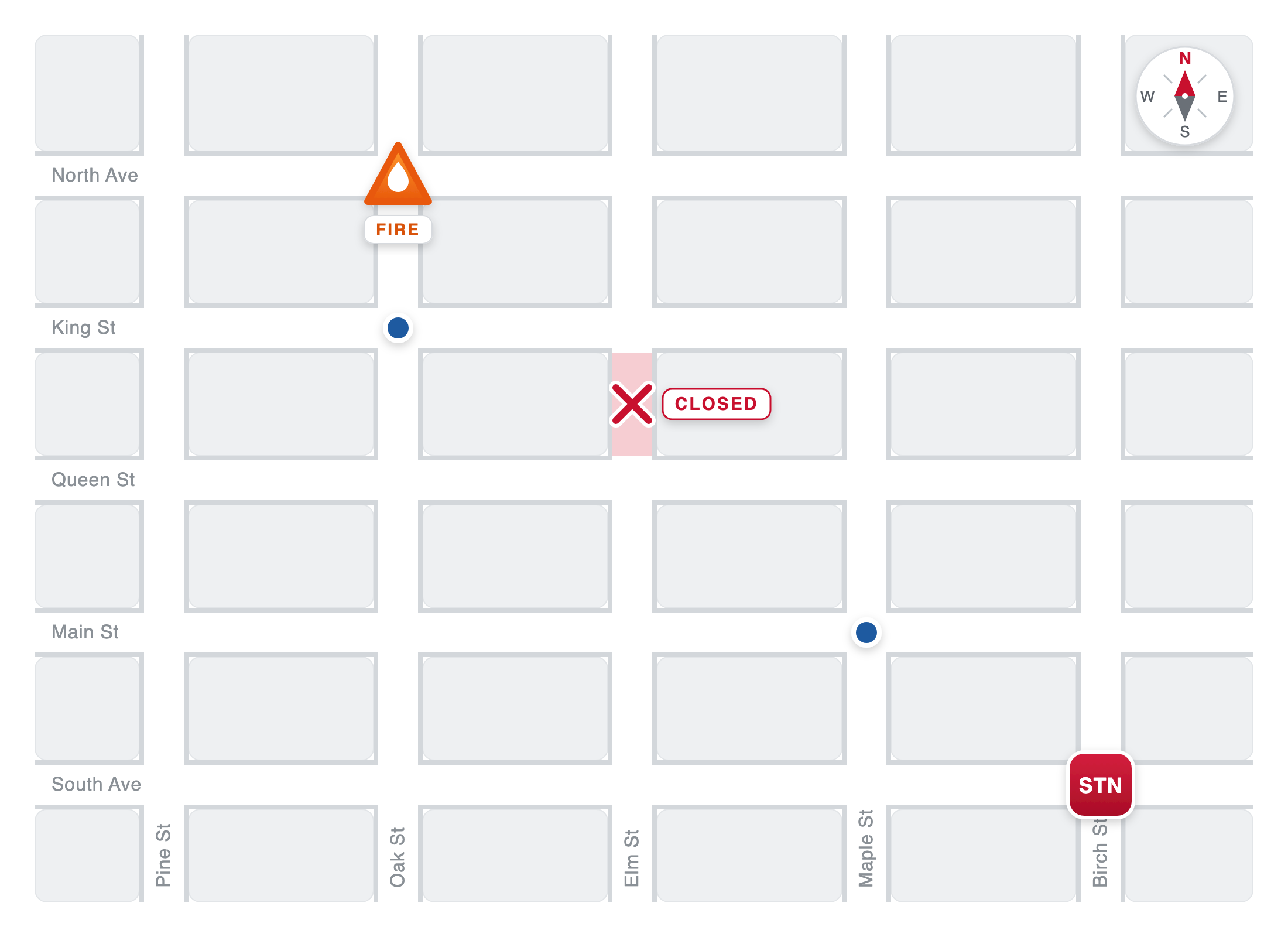
From the station (STN) at Birch St and South Ave, the crew must reach the fire at Oak St and North Ave. Elm St is closed between King St and Queen St. What is the minimum number of blocks the crew must travel?
- A. 6 blocks
- B. 7 blocks
- C. 8 blocks
- D. 9 blocks
Show answer & explanation
Answer: B. The straight-line street distance is 3 blocks west + 4 blocks north = 7 blocks, and routes exist (e.g. north on Birch to North Ave, then west) that avoid the closed block of Elm St without any detour. The minimum is 7 blocks.
About this section
- Map Reading is one of the six official NFST constructs (FPSI): grid coordinates, compass directions, and route-finding.
- Question counts are not published by FPSI — announced on test day.
- Tests whether you can navigate a district map under time pressure, a daily skill for apparatus crews.
- Strategy: fix “north is up” before anything else, then trace each move on the map with your finger or cursor — visual tracing beats holding directions in your head.
Want full-length practice for every NFST section?
Timed simulations for reading, math, map reading, human relations (best/worst pairs included), and reasoning drills — all written in Canada, in Canadian units, for Canadian recruitments.
4. Human Relations — the best/worst pair format
This is the NFST’s signature format, and the reason one scenario below produces two questions: the NFST asks for the MOST effective response and the LEAST effective response to the same situation, from the same set of options. Knowing the best answer isn’t enough — you also have to identify which option actively makes things worse.
Scenario: You are a probationary firefighter at Station 4. A senior firefighter on your crew regularly re-does tasks you have completed — refolding hose rolls, rewiping tools — while making sarcastic comments about “rookie work” in front of the crew. Your work follows exactly what you were taught in recruit training, and the behaviour is starting to affect your confidence.
Question 1 of the pair: Which response is the MOST effective?
- A. Ask the senior firefighter privately what you could do differently so your work meets the standard he expects.
- B. Quietly re-do your own tasks a second time before he inspects them so he finds nothing to criticize.
- C. Tell the other probationary firefighters that he is unfairly targeting you and to watch out for him.
- D. Say nothing and avoid working near him, hoping the comments stop on their own.
Show answer & explanation
Answer: A. Direct, private, respectful communication is the fire-service standard for resolving crew friction: it treats the senior member with respect, invites mentorship, and may reveal a legitimate standard you have not yet learned. Addressing the person involved before anyone else preserves crew trust.
Same scenario, same four options — now the paired question flips:
Question 2 of the pair: Which response is the LEAST effective?
- A. Ask the senior firefighter privately what you could do differently so your work meets the standard he expects.
- B. Quietly re-do your own tasks a second time before he inspects them so he finds nothing to criticize.
- C. Tell the other probationary firefighters that he is unfairly targeting you and to watch out for him.
- D. Say nothing and avoid working near him, hoping the comments stop on their own.
Show answer & explanation
Answer: C. Complaining about a crew member behind his back spreads the conflict instead of resolving it, damages crew cohesion, and violates the principle of addressing concerns directly with the person involved. Gossip corrodes the trust a fire crew depends on.
About this section
- Human Relations, combined with the personality inventory, drives 55% of your NFST result (FPSI) — this is where tests are won and lost.
- Scenarios cover crew conflict, chain of command, integrity and gifts, and interactions with the public.
- Notice the trap in the LEAST question: the tempting wrong answer is rarely the obviously bad one — here, gossip (C) beats passive avoidance (D) for “least effective” because it actively spreads the conflict.
- FPSI does not publish how many scenarios appear; counts are announced on test day.
- Strategy: rank all four options from best to worst before answering either question of a pair — the two answers must come from opposite ends of your ranking.
5. Reasoning Skills — detail-checking, sequences, and rotation
Compare the incident addresses recorded by two dispatchers. One row does NOT match exactly.
Row 1:  4821 Birchmount Cres    |  4821 Birchmount Cres
Row 2:  1157 Kettleby Line      |  1157 Kettleby Lane
Row 3:  763 Silverthorn Ave     |  763 Silverthorn Ave
Row 4:  2209 Fallowfield Rd     |  2209 Fallowfield Rd
In which row do the two addresses differ?
- A. Row 1
- B. Row 2
- C. Row 3
- D. Row 4
Show answer & explanation
Answer: B. Check the street-type suffix as its own unit, not just the numbers and name. Row 2 reads “Kettleby Line” in the first column but “Kettleby Lane” in the second — a one-letter substitution that changes the address. Suffixes (Line, Lane, Rd, Cres) are frequent error points.
About this section
- FPSI confirms Reasoning Skills is a mixed construct that includes mechanical reasoning, spatial rotation, and vocabulary items — the error-checking drill above trains the same rapid detail-verification skill.
- Expect variety: number series, analogies, odd-one-out, rotated shapes, and clerical accuracy checks.
- Item counts are not published by FPSI; announced on test day.
- Strategy: on comparison items, check in chunks — numbers, then street name, then suffix — rather than reading each line as a whole; the eye glosses over one-letter swaps in full-line reading.
What about the Writing Ability section? It tests grammar, punctuation, and sentence construction — the identical skill FPSI tests on Ontario’s FACT. We cover it with samples on our FACT guide rather than duplicating it here.
Which departments use the NFST in Canada? Halifax and Vancouver
As of July 2026, two major Canadian departments are confirmed FPSI users — and they use the test differently:
Halifax Regional Fire & Emergency lists the “FPSI Online Firefighter Test” as its entrance exam, written online from home rather than in a test centre (halifax.ca). The 2026 online sittings were held February 4 and 7; check halifax.ca for the next recruitment cycle’s dates before planning your prep timeline.
Vancouver Fire Rescue Services uses the NFST-CFT, a variant FPSI confirms combines the standard NFST with technical questions drawn from IFSTA Essentials of Fire Fighting, 6th Edition. Vancouver candidates need to study actual firefighting fundamentals from the IFSTA text on top of the aptitude and human-relations material — a genuinely different prep job from Halifax’s.
Confirmed FPSI test users in Canada (as of July 2026)
- Halifax Regional Fire & Emergency (NS)
FPSI Online Firefighter Test — written online from home; 2026 dates were Feb 4 & 7 (halifax.ca) - Vancouver Fire Rescue Services (BC)
NFST-CFT — NFST plus IFSTA Essentials of Fire Fighting 6th Ed. technical questions (FPSI)
Ontario departments use FPSI’s sibling exam, the FACT, administered by OFAI — see our FACT guide. Department requirements change between recruitments; always re-verify on the department’s own site before booking.
FAQ
Is the NFST the same as the FACT — and which test does my department use?
No. Both are published by FPSI and test the same family of constructs, but they are different exams: Ontario departments use the FACT through OFAI, Halifax uses FPSI’s online firefighter test, and Vancouver uses the NFST-CFT. Watch the name-collision trap too: FPSI’s National Fire Select Test is not Stanard & Associates’ National Firefighter Selection Test (US-only, reading/math/listening) and not IO Solutions’ NFSI. Three different publishers, three different exams, nearly identical names — confirm the exact test named in your department’s posting before buying any prep.
How many questions are on the NFST and how long does it take?
Honest answer: FPSI does not publish the total question count or time limit — they are announced on test day. Prep companies commonly assert “about 100 questions, 2–2.5 hours, 70% to pass,” but none of those figures are publisher-confirmed, so treat them as unverified. What FPSI does confirm: items have 4–5 answer options, scoring is number-correct, and there is no penalty for guessing — so answer everything.
What is the NFST-CFT that Vancouver uses?
The NFST-CFT is FPSI’s variant used by Vancouver Fire Rescue Services. It combines the standard NFST sections with technical questions drawn from IFSTA Essentials of Fire Fighting, 6th Edition. If you’re testing in Vancouver, add the IFSTA Essentials text to your study plan — the aptitude and human-relations prep alone won’t cover the technical component.
Is there a practice test for the NFST personality inventory?
No official practice version exists — and anyone selling “real” NFST personality questions is not selling FPSI material. The productive approach: understand the traits fire services screen for (teamwork, honesty, integrity, emotional stability, professionalism), answer consistently and honestly rather than trying to game it — inventories are built to flag contradictory answers — and put your actual practice hours into the human-relations judgment questions, which are scoreable, learnable, and heavily weighted.
Preparing for a different exam?
Ready to train for the sections that decide 55% of your score?
Our practice bundle includes best/worst human-relations pairs, reading passages, no-calculator math, map drills, and reasoning exercises — built in Canada for FPSI-style testing. Includes the FR Study Series — a dedicated NFST study guide plus 15 more, with lessons and worked examples.
Or start with the free practice test — no email required.
What to Look For in Any Firefighter Test Prep
Whichever provider you choose — including us — hold it to these six checks before you pay:
- ✓Matches the exact test your department names. FACT, NFST, FSO/CPS and FireTEAM are different exams with different sections — generic “firefighter test” packs waste your prep time. See our overview of every Canadian firefighter aptitude test if you’re not sure which one you face.
- ✓Format fidelity, not just topic coverage. If your exam delivers passages by audio or scenarios by video, text-only practice trains the wrong skill. Look for single-play audio for listening sections and scenario continuity for video-based tests.
- ✓Worked explanations for every question. An answer key tells you what you got wrong; a worked explanation tells you why — that’s where score improvement actually comes from.
- ✓Canadian content and units. Metric distances, Canadian spellings, Canadian department contexts — and pricing clearly labeled in CAD, so there’s no exchange-rate surprise at checkout.
- ✓Access that matches a real recruitment cycle. Canadian hiring processes run months, not weeks. Clear one-time pricing with long access beats short timed windows you may have to re-buy mid-process.
- ✓Facts it can source. Good prep cites the test owner’s official pages, dates its claims, and says so honestly when a number (like a pass mark) simply isn’t published — instead of asserting one.
Testing in B.C.? Many B.C. departments — Surrey, Richmond, Coquitlam, Abbotsford and more — screen through the BL Associates psychometric battery instead. Read our BLA firefighter test guide.
The National Fire Select Test (NFST) is a trademark of Fire & Police Selection, Inc. (FPSI). firerecruitment.ca is not affiliated with, endorsed by, or connected to FPSI, Halifax Regional Fire & Emergency, Vancouver Fire Rescue Services, or any fire department. Our practice materials simulate the format and skills tested; they are not actual exam questions. Format details verified 2 July 2026 against official sources where available; specifications marked “reported” or attributed to prep providers are not publisher-confirmed. No total question count, time limit, or pass mark is published for the NFST; we make no pass-rate or hiring guarantees.